
2.1 Reflection
2.1 Reflection
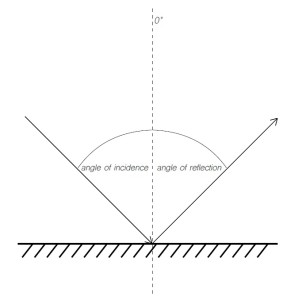
Generally, if the light is reflected, the reflected beam remains in the plane and the angle of incidence equals the angle of reflection, measured from the axis perpendicular to the surface.
Now, it depends much on the features of the surface, how the reflected light would look like: if the surface is flat and bright (at the micro level – don’t forget that waves of light are pretty small), the majority or all the rays are reflected in the same direction and thus the original images can keep its shape. It is called specular reflection, a mirror being typical example of it. This kind of a surface will look very bright, but only if viewing from a specific angle and probably only on a particular place. From other sides, it may look dark.
A rough surface with high unevenness (again at the microscopic level) causes the light to be reflected in many directions as the light is reflected in the same angle. When the beam of light is dispersed, it is called diffuse reflection. The light bounces off the reflector (typically felt) in all directions. This kind of surface looks similarly if viewed from different angles.
Most of the surfaces we usually meet reflect more light in the angle equal to the angle of reflection, but they also reflect light to other directions. You have probably observed this while looking onstage – backlight seems to be more visible on the floor then light coming from the front, although they have the same intensity. It is because a larger part of the backlight reflected from the floor goes directly towards your eyes.
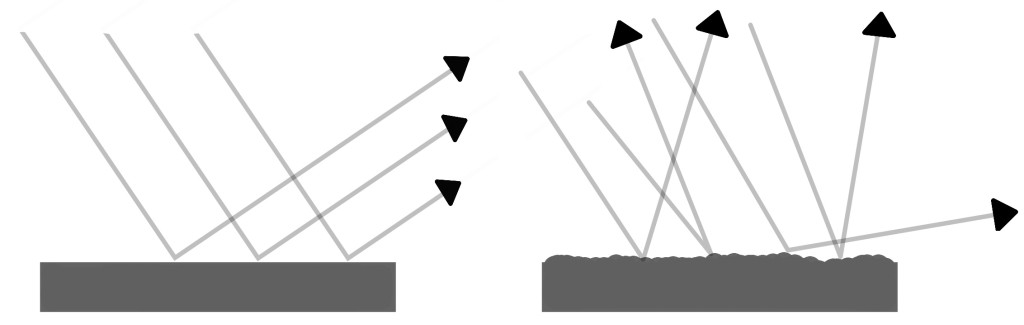
Specular and difuse reflection.

At an uneven surface, light is dispersed in various directions. We see the reflection of the sun at the areas, at which the angle of incidence directs the rays to our eyes.
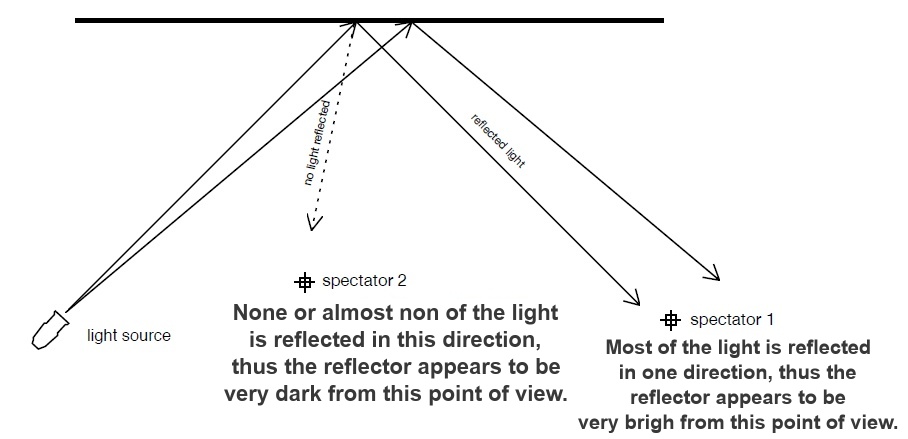
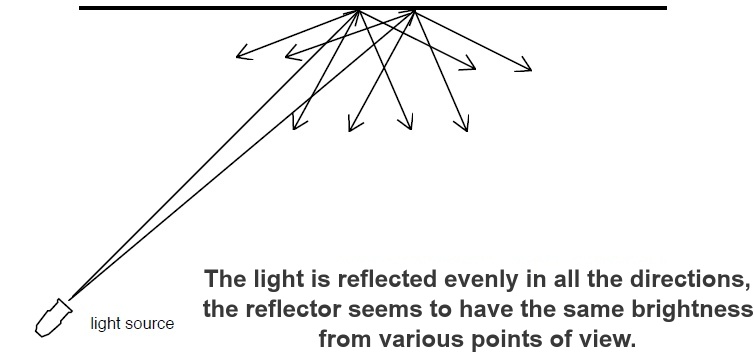
All this sounds logical and there is nothing surprising in it. Does it have any use for the stage lighting design? Let’s put the following example to the test.
Let us imagine a quite simple set: on the stage, there is a round table with a glass table top and two chromed chairs, a silver bowl on the table. The rear section is composed of a wall from white PVC with a glossy surface finish.
Because all the mentioned set elements reflect the light mostly in one direction, because they are lustrous, you will have to meticulously locate and focus all fixtures so the reflection from any lustrous surface (and there are many) wouldn’t shine to where it shouldn’t – into the spectator’s eyes, onto the wall of the auditorium, onto other part of scenery etc. This itself is a lot of work, but the simple law of reflection is sufficient. The entire stage will have to be meticulously masked so the technical background can’t be seen, to where probably the light would fall.
If you have the intention to directly illuminate the walls (for instance in various colors), the angle of incidence has to be carefully chosen (and so the position of the instrument) – for example, if it is to be illuminated from the front, the spectators will be probably dazzled – they won’t see the walls, but shining lenses of the fixtures. But if you select a more steep angle, dazzling will be avoided, but the major part of light will be reflected from the floor uselessly.
This theoretical knowledge is thus beneficial in the way that a lighting designer should be able to foresee what kind of a material would look like under the light of various fixtures, to react adequately or even to influence which material would be used in the preparation phase.
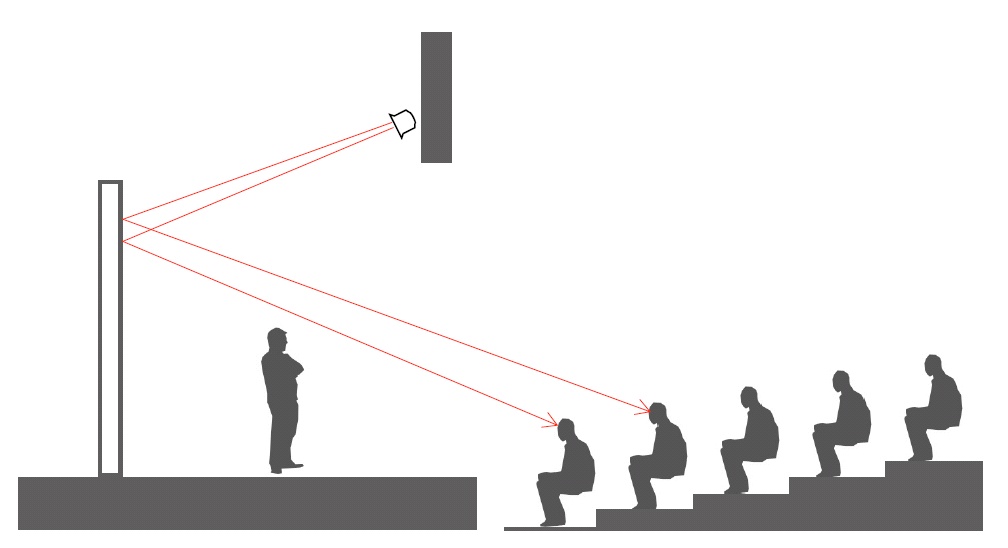
Reflection blinds audience.
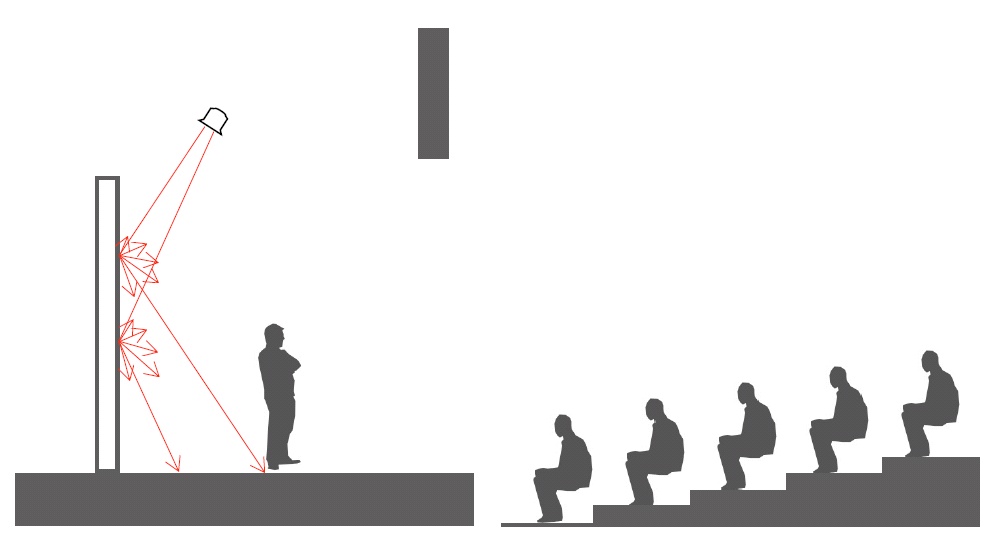
A major part of light gets away.