
2. Focus sheet
2. Focus sheet
Similarly as a light plot serves as a plan for correct hanging of lighting units – set up, a focus sheet serves for correct instrument focusing. In some cases, the light plot and focus sheet can be overlaid on a single sheet. However, it’s usually a separate document, which indicates clear instructions to the focus itself of individual fixtures. It can concern a sort of a script in pictures, in which the precise trajectory of the light beam is plotted or it might be a chart, in which all the fixtures or their groups are recorded and the focus is described in words. Some of special programs can make 3D visualization and it is not uncommon in the contemporary digital era to record the focus of the instrument as a photo with a phone… Often, it is necessary to combine various approaches to create a good focus sheet. It is sometimes easier to draw a part of scenery set into it and the approximate shape of the light beam, another time, it is possible to precisely describe the same with words and sometimes, a photo can help.
As a focus sheet, usually also the so called magic sheet can be used. A magic sheet (sometimes referred to as a “cheat sheet”) is a quick reference, usually only one or two pages long, giving quick visual access to the lighting designer, sorted by purpose, to each channel and the fixture(s) it controls and focus.
However, a magic sheet, because of its nature, can only hand over the information only to a lighting designer who himself has drawn it for his own needs. A focus sheet should be more comprehensible for other members of the team as well.
A good focus sheet, similarly as a good light plot, transfers information to other people in an intelligible way. After first several performances, focusing of a performance is going to be executed usually by a chief lighting technician with a team of technicians, not the lighting designer. During a new presentation in a different city, it might be perhaps an assistant of the lighting designer or whoever would be in charge of it. And last but not least, not even the lighting designer can remember every detail, which he has created during his feverish efforts.
For that reason, it is necessary to pay as large attention to the focus sheet as to the light plot. It can be said that in an ideal world, a professional who hasn’t seen the given piece should be able to focus the performance according to a well written focus sheet.
There are several important attributes, which are important for the focus that should be recorded in a focus sheet.
The number of the fixture, respectively channel or dimmer, under which the fixture is controlled.
Direction and dimension of the light beam (to where the light beam from the fixture is directed)
An example: forestage right, half a meter onto the proscenium arch.
Shape of the light beam – are the barn doors used? Or Gobo by profiles? Is it focused or blurred? How is the Gobo turned?
The type of the fixture, position of the fixture, color (it’s often marked in the light plot and so it’s not important for the focus itself. Still, a focus sheet should contain such information for the better orientation).
Intensity (sometimes it’s beneficial to note into the focus sheet the maximal intensity, for which the given instrument is used and to focus it at this intensity)
Other information (sometimes it’s necessary to check focus for instance with another scenery piece, instead of the one the fixture was focused to. A note should help not to forget to check the focus with a changed scenery piece)


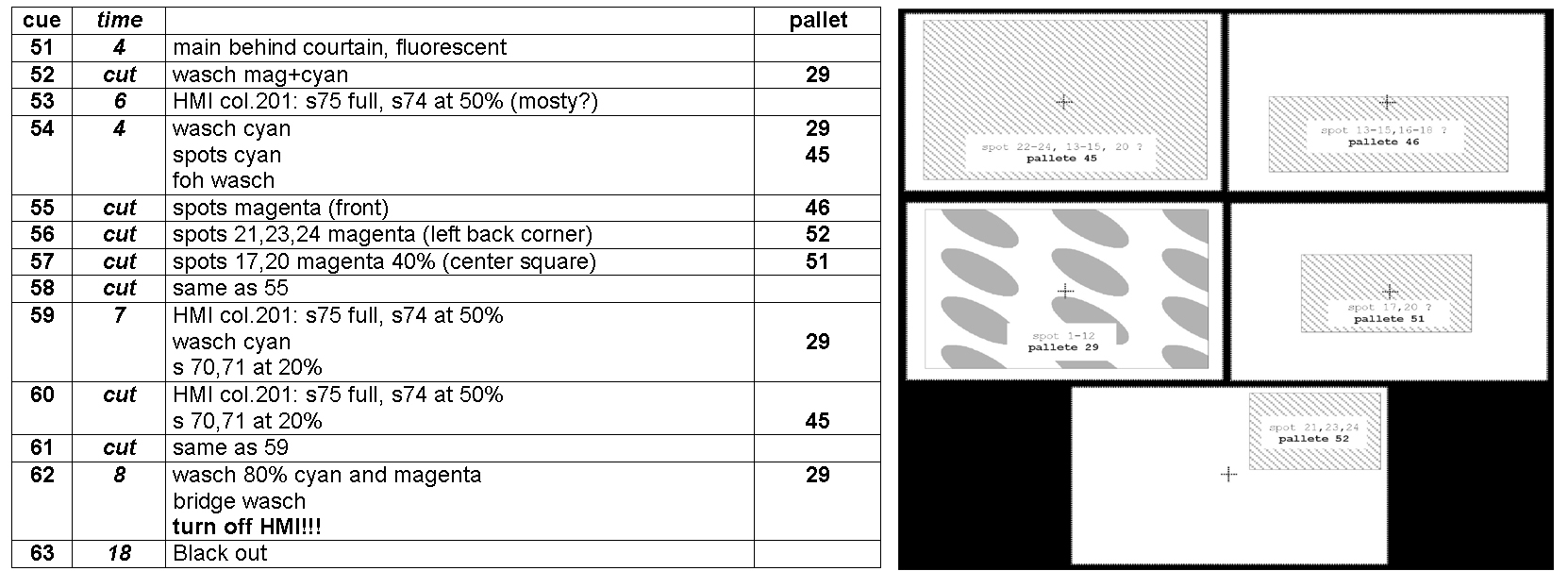
The five images contain plotted focus of spot lights ( spots are set up automatically, the images of the focus are here only for control and they originally served as a magic sheet at the same time) and a cue sheet, which is going to be a topic of the next segment.

A focus sheet provides information to where the individual lights or groups are going to be directed. Similarly as there is a great variety of spaces, also the necessary information that might be conveyed in the chart would vary. Generally, it would contain a dimmer channel, focus area and color.
3. Cue sheet
A cue sheet is a document where all the cues, which are contained in the performance, are recorded. In essence, it is actually a lighting script, which says when and which lighting cue will be on in a given moment at the stage.
In order to have the documentation of cues complete, it should contain the time of fading in and fading out of individual cues apart of the number of the cue. Possibly other attributes concerning time (Delay, wait, followOn, Loop, Link).
It may include information when the light change will be executed. (“Romeo comes”, “with new music” or an extract from dialogue with marked place when it is necessary to execute the change)
Furthermore, it may contain the content of the light change as well (blue backlight wash at FULL, warm sidelights set at 45%, front ramp at 20%), or just a short note (morning atmosphere). That might help to an operator to good orientation during the show.
But definitely, at least those cues should be always marked, which don’t contain any lights – that is blackout. That is for many good reasons as any operator can confirm that.
A cue sheet can be complemented by a script of follow spots. It is so recorded, which follow spot is directed on which performer and other details at each light change.
There is no standard for a cue sheet as there’s any for a light plot or focus sheet. Some have individual cues noted in the script with a pencil; others prefer a list of cues with its content that is itemized in detail. When there is a frequent rerun, some operators don’t even use any cue sheet anymore, they simply “remember” the performance. That doesn’t change the fact that a detailed cue sheet is a component of a good documentation.


