
3. Genres
3. Genres
3.1 Drama
Angle, location, and distance are a determining factor that would set how the light and shadow would be perceived.
The direction of light is a key factor for the viewer’s perception, with which it is possible to organize space, render the scene as well as it’s a desirable way of highlighting performers. In accordance with the genre, there are techniques that can achieve the desired impression – e.g primarily visible facial expressions, gestures and delineation of figures in drama and pantomime, as well as the modeling of a scene, including its changes, in dance of expressive expression, drama and dimensioning of space (rather than scenography). In addition to selection of the type of lanterns to suit the purpose, the directing of light is precisely one of the first tasks of a lighting designer, it is actually even before that in the work order. While the variety of available lights in the theater space can be extended by a rental (external hiring), directing options are often limited by the architectural design of technical facilities, including the type of theater space. The classical proscenium theatre has been perfected throughout the centuries, although in many theaters, the possibilities are limited due to historical monument preservation. Lighting equipment in many proscenium theaters contains three washes at each side that are focused to light faces of actors.
In addition, a small classical theater with similar architecture can lack a sufficient number of possible positions from the position of the auditorium (FOH) and on stage (forestage battery, fly bars).
In regard to the direction of light, there are also used the concepts of light angle and spotlight position, which help determine the desired effect. These factors are dependent to a large extent on the architectural solution of technical facilities (possibility of suspension points) and one can often run into limits that theater space pose to the ideal direction of light according to plan. For example, from the aspect of the position, large stages are usually not limited by the possibilities of spotlights location (several auditorium, stage bridges, side bridges, tower of the proscenium arch, flybars, etc.), while usage of one spotlight is only few times sufficient for even the chamber, concise image.
Angles of lighting are one of basic means of expression and its usage has not only visual potential, but has an effect on the psychology of perception. The main requirement for (not only) drama theater is good visibility of the performing gestures and facial expressions, which means sufficient intensity and appropriate directing of instruments (FOH, front, i.e. in the direction of the viewer). As much as the position of the lights concerns, the ideal angle, in relation to a standing figure, is 45° (30 to 60°) in the vertical and horizontal direction. Light with such direction is the one, which does not throw distracting shadows under the eyes and nose while portrays the volume of a character more flexibly. To do this, you must have the appropriate position, i.e. adequate height and distance of suspension points, so that it is possible in this manner to cover the entire stage, with several rows of these front lights according to its size. A large role is also played by the angular extent of the cone of the used light.
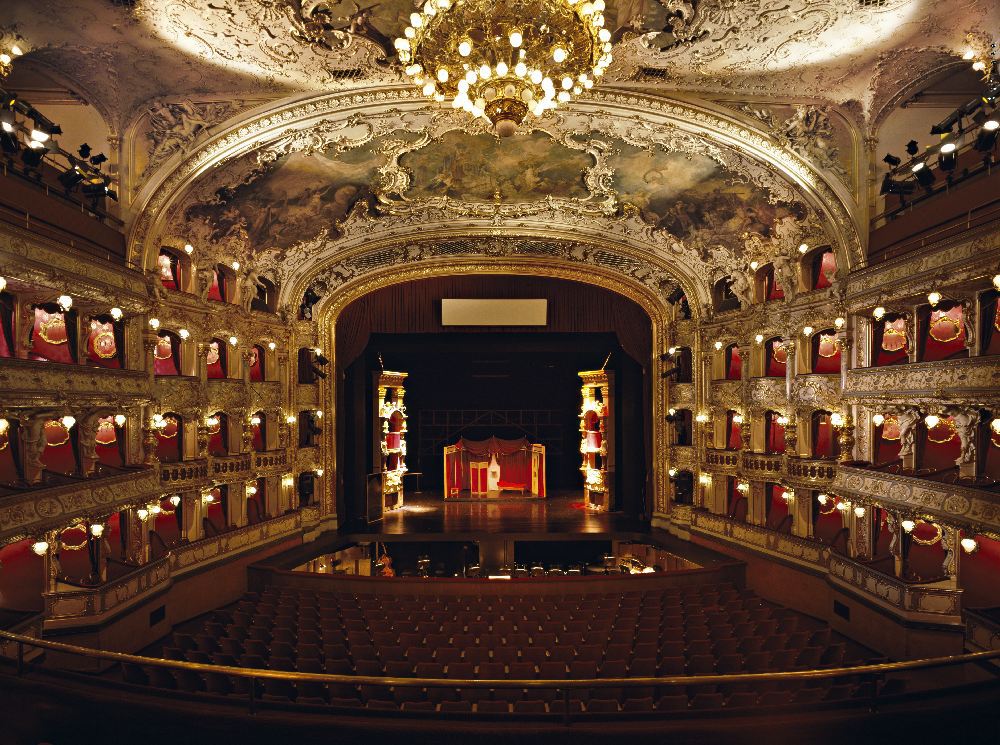
Classical proscenium stage theater, State Opera Prague.


In the Czech Republic, the standard is to use FOH lanterns, PC or Fresnel on these positions, in the Anglo-Saxon world, one can often come across profiles. If such an ideal position is not available or there is a need of supplement lighting, it is possible to add light with direct front light, which visually makes three-dimensional objects more flat and according to the size of the vertical angle, it can throw long shadows (i.e. by the low position of the spotlight). The front ground position at the edge of the forestage was used already in the Baroque theater, where a large number of sources in a row was placed. By itself, this direction has a specifically expressive impact (almost “ghostly”), it casts petty shadows on a figure and a distinctive shadow on the backdrop, but it can help to eliminate shadows on the face in combination with other upper front lights. More of these ground sources adjacent to each other deletes each other’s shadows on the backdrop and provides soft light.
For balanced “place”, however, the front direction of the light is not sufficient, because it is not sufficiently plastic to the volume of figures, objects. It needs to be more supplemented by side light, which both delineates the volume and adds light to the figure for utmost range of viewers, whose viewing angle is different than in the middle of the auditorium. Also it’s not an insignificant fact as well that the actors, having a dialogue face to face, see the entire partner’s face very well thanks to side lighting, not only a half from the side of the audience, which is more comfortable in terms of actors’ actions. These side lights should not be too low so that the actors would not shield each other. In perfectly lit space, the side lighting is still absent, i.e. away from the backdrop to the audience, which drawn contours of characters in appropriate intensity of proportions. For the location of the backlights, it is crucial to choose their vertical angle, hence their number in the depth of the stage, so that the lanterns wouldn´t dazzle spectators in the front rows.
To cover that, borders are used – stripes of velvet hanging in the front of such a battery of back lights, screening a direct view onto the hanging lantern to a viewer. A specific issue is, namely in the drama, when a realistic environment with a single “natural” light source is simulated on the stage, (whether it’s interior, exterior, day or night) there is a custom that the scene should look like in the real life – lit by a natural source, thus throwing only one significant shadow: e.g. in the exterior caused by the sun (shadows depending on the different time day – differently shifted), similarly as in the interior, a filler with sunlight from the window or with light lamps at night indoors. It is a question of appropriate directing and adequate intensity of functional lights and distinctive light of a “natural” source. In the case of set design on the stage, directing of light is also an essential visual element. It is possible to seek to achieve confirmation of natural atmosphere, thus lighting decoration with an accent of a natural source.
There are some factors and techniques that need to be taken into account
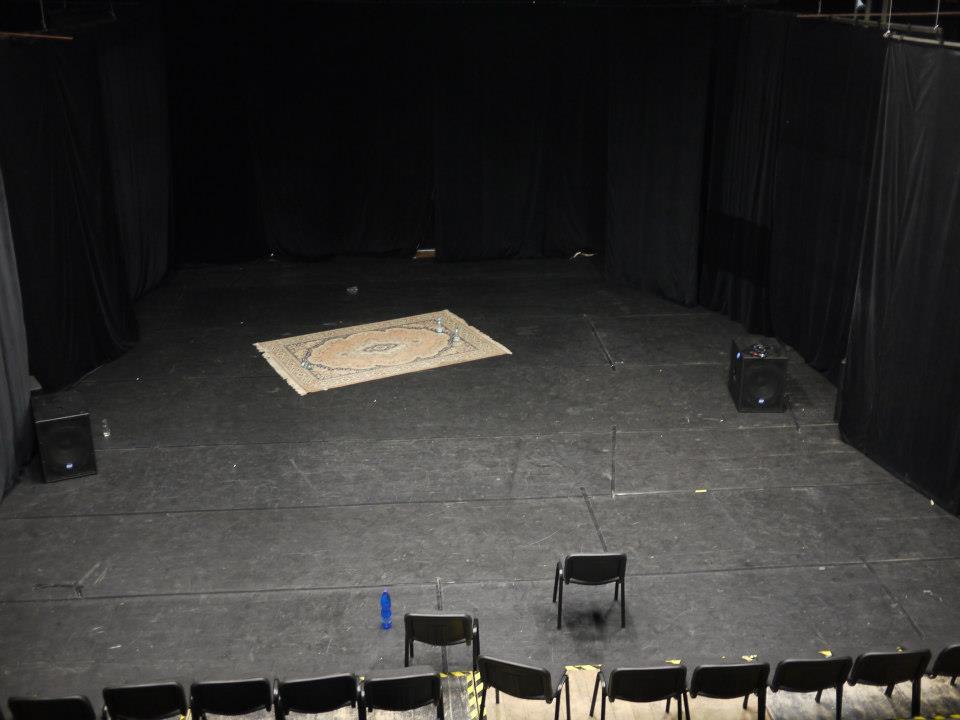
There might be shiny objects at the stage that reflect light, it depends much on materials of which costume and set design are made. That is called stray light and it’s rather to be avoided. The considerable reduction of stray light can be achieved in a “black box” as the space is covered in black with black legs.
The dynamics can be given to light when its source of light itself would be moved in the space. With swaying of light sources, their light would be scattered onto the surface in irregular intervals. When shutters with carved openings are used, a moving shadow drawing can be reached.
Growing of an object can be achieved when the object is lit by more sources of light with wider diameter of a light beam or the space could be unveiled gradually with more and more sources of light, which are in a given composition.
Using other light than white changes the colors of the items in the set design including dress.
The light from any other angle than the right above the actor casts the light onto larger area than is used by him.
The sharper the angle, the smaller the lit area, the less is dispersed the light outside the area that is to be lit.
Naturally, the part of light that doesn’t hit the object continues travelling further and casts light onto whatever is going to be the next thing in its way.
Some devices of the wash can be used as specials and in that case, any such reflector has to have its own circuit and dimmer.
Objects are modeled by their convenient lighting, where a perspective might be in play. And the light can used for intended deformation of the space.
The shadows that are cast by the main source of light are usually filled by the light from the source of lower intensity, inducing the perception in a complementary color.
Sharp angels create distinctively defined areas that offer a better possibility of being of higher intensity and thus attract the spectator’s attention better. Sharp angles cannot reach the actor’s eyes, which might be inconvenient for his expression. So a kind of compromise is needed between sharp and obtuse angles. The latter would lit eyes and the face below the nose and help to avail the facial expression on one side while having a tendency to flatten the scene. On the other, it casts light onto a part of the floor, which is usually not wanted or creates potentially disturbing shadows .

FOH at the Estates Theatre, Prague
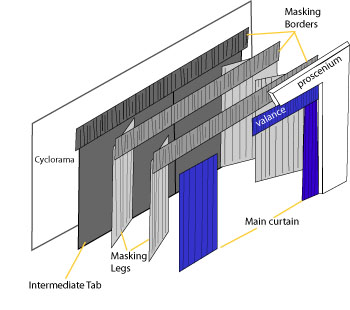
masking


Direction of light plays a large role in lighting of museums as well.


Wash and special
Many lighting designs can be seen as a composition of washes and specials.
3.1.1 Wash
In theater, it is quite impossible to cast light onto a large area with only a single source of light. That might have its flaws as merging of light can be problematic, but has its advantages as well as different sections can have different intensity of light.
Wash is lighting of a larger area with blurred edges, it is usually composed of several lighting devices or lanterns that are labeled wash lights. As the several sources of light for lighting of a larger area are likely to be used simultaneously, their control of their intensity can be joint into a “group”, which is a name at the same time for several channels under a single controller.
Wash is thus the term for light of homogenous quality on a quite large section of the stage, lighting of large surface in a scene, usually from multiple lanterns (eg. front wash, rear blue wash, etc.) and so it is reasonable to use it for color-toning of the scene.
Its main quality is homogeneous distribution of the light in the beam all over the entire area. Usually, wash is used for “flooding” of the stage. The automatic wash often uses Fresnel lenses. The angles of emitted light oscillate from 5° up to 87°. For enlarging the span of angles, diffusive filters that defocus the light beam are inserted, which endorses the consistency of the beam. These types often contain carving blades as well. It is used as in theatres as in concerts, events, installations and TV studios. It is possible to color the background or backdrop fully, but can be used for front lighting as well. The entire scene can be shaped into one color atmosphere with only few lights.


Overlapping of beams.
3.1.2 Special
Special (Spot) is lighting of a small area with a sharply edged beam, usually created by a single lantern. Follow spot follows the actor’s movement in detail. (eg. the top spot, front spot, etc.)

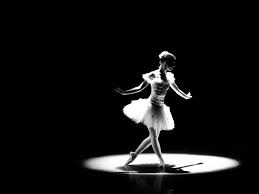


3.2 Dance
In contemporary dance, the criterion of sufficient frontal illumination is not the primary one, so a lighting designer has more freedom to choose the direction of the light to express his “image”, however, that doesn’t mean that the viewer doesn’t need to be provided with good conditions for seeing the action, it may be even more demanding in a certain sense.
In the dance, side lighting is crucial, which means sidelights in the direction of about 90 ° from the perspective of the viewer, located at low heights. Their advantage is (in the case of good coverage of the stage by suffites) “invisibility”, in any case, the ability to portray plasticity of dancer’s figure. In full scenes, side lighting certainly cannot be absent. Here, however, it should be noted in relation to the angle of light that the height of the position of the spotlight is decisive for comfortable lighting: if the side lights are placed on a tripod on both sides (or on the ground), the complete figure will only be visible on the opposite side of the stage – right performer will be lit only on the left and vice versa. To achieve a compact lighting across the width of the stage, it is necessary to use spotlights at least in two (preferably three) heights (ground + tripod about 1.5 m or ideally ground + tripod about 1 m + tripod about 1.8 m). Another major component of a dance performance is back lighting, delineating the contours of figures and – particularly in dance – often determining the depth of the scene / space.
The angle of light plays a big role. The high position of back lights highlights contours of characters and gives a frame, dimension, to the stage space, they have a distinctively dramatic impact on the scene. The low-mounted back lights at a wider angle (the spotlights can be present in the visual field of a viewer) enhance the contrast between the dark silhouettes and its lit surroundings, without being too revealing or being too specific for the scene. By back lights, the choice of the spotlight has a big influence – e.g. the back spotlights PAR at low intensities creates narrow cones, which bestows a dynamic play of light and shadow on the scene, next to that, the Fresnel with great intensity lights the scene up, but the performer is still seen only in an outline. Because the direction of light changes point of view, this may be another mean of expression. An integral part of the dance performances is the so called specials that are designed for specific lighting of (performer’s) action in (to him) a defined area.
Direction of light and its angle, including the choice of a type of spot lights, is very much optional in this case and it principally concerns highlighting a detail in relation to the surrounding scene, focusing attention to an important event or change in the current flow of theatrical space-time. It may be a point beam, back, front, but the term special carries really wide possibilities. In regard to the fact that the theater of movement rarely uses scenography, even symbolically minimalist one, the light on the stage very often plays the role of a set design , i.e. it determines or implies or illustrates scenery, environment, sets the dimensions, creates the architecture of space. The light here then plays a dual role – the first that it illuminates a dance event including the atmosphere, the second that it determines the spatial context of this theater imagery, in other words, it forms the scenography. In particular, there is a need to consider both components separately in such a manner that the action would not be accompanied only by some kind of an environment and to the opposite, that the theatrical metaphor of certain space would not be too limited for the performer. This light- scenographic approach has its advantages, among others, that it can easily change a specific scene into general space that is not delimited more closely, but with its own atmosphere. It’s the task of a lighting designer, in collaboration with the director and / or choreograph to design the light.
That is appropriate to the action in such a way so the scene would not override the action.
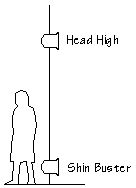 Everything contained herein is true even in situations that are specific for some kind of a cause, whether it’s because of work in another type of theater space, because of using projections, a particular genre or technical limits. Arena, circus tent may be an example of non-standard space where it’s necessary to take into account the comfort of spectators who sit three in three, four sides in a circle. It is necessary to pay attention to the rule of sightlines, i.e. that it’s indispensable to provide adequate lighting for any viewer (front, side, back light), plus the lighting must not cause distracting, dazzlement. In an arena of four sides, it’s not very easy to fully cast light onto the full scene without compromises. If genre specifics are noted, let’s mention at aerobatic performances, where the performer needs adequate levels of light for his action and he also must not be dazzled (juggling, tightrope walking, etc.)


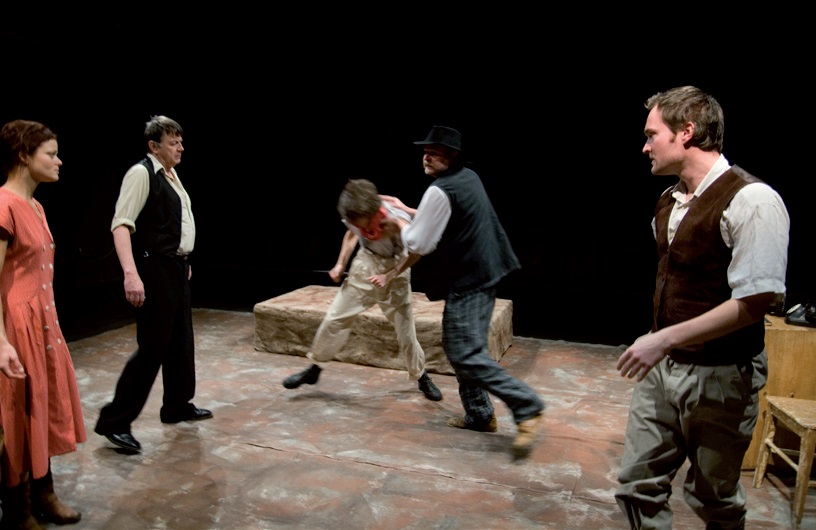
Although it’s not very much visible (the photographer deliberately suppressed the auditorium around), this performance is played in an arena between two auditoriums; actors have sufficient light from both sides (see shadows), plus the characters shadows are very soft (thanks to the moiré floor surface), so it is possible to estimate the quality of lighting in the scene in both desired directions; worth noting is the shadow in the face of a man in a hat – a difficult task on the classical stage, the more on the space in an arena theatre (Photo: Thomas Lohin; performance Businessman with rain, Theatre Na Prádle)
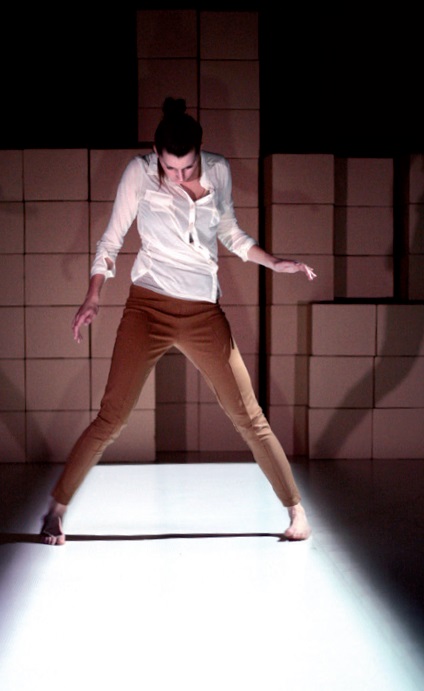
In the modern theater, where lots of multimedia is used, it is common to project images even onto the floor of the stage; it is advantageous to use bright surface for maximum brightness of the cue, but that, however, reflects any other light as well apart of projections disproportionately to the effect that is desired on the figure of the performer; in this case, there is probably only one way (without image degradation) of using sidelights; on the picture, the dancer works with an interactive projection (white stripe on the floor), the projector is placed near to the ceiling on the right as follows from the shades on the legs, so the light from the projector lights only the lower third of the body; for the viewer seeing, the scene is complemented by three front headlights on the ground (see shadows on the backdrop) with little intensity and color correction (Full CTB, tungsten cold to reduce the contrast between discharge lamp and bulb of the headlamp), so the figure would be enough lit.