
3. Other types of lights
(Properties of instruments differ according to a manufacturer, determination of the used technology and quality. The following list is not typologically uniform.)
In addition to these basic conventional lights especially in music productions, more variable instruments are commonly used today that are not connected to electrical dimmer circuits and are directly controlled by DMX commands.
3.1 Low voltage
There is a transformer in front of the lamp, which regulates el. current from 230V to 6V, 12V, 24V, etc. The source is a low voltage bulb, but it emits an intense, but narrow beam (about 5°). The low voltage are some PAR’s (pinspot, ACL), further low voltages are often a part of the battery (the legendary Svoboda battens), and also DPR 250W by the company Artlighting.
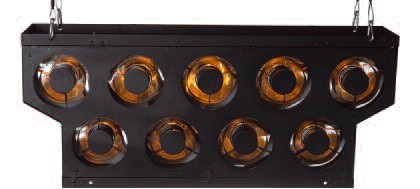
Svoboda batten

Low voltage spotlight 250W 24V
3.2 Fluorescent
Lighting by fluorescent tubes. Problematic dimming technology has limited its wider distribution. Currently, there is large popularity of fluorescent light thanks to the cold spectrum of the quality of light.
3.3 LEDs
LEDs (Light-Emitting Diode) are a promising source of light in all regards of its use because of its features (low energy X high performance, long service life, a wide range of colors and combinations, manufacturing cost etc.). Development of LED technology is so dynamic that the lights fixed with LEDs penetrate through previous typologies and their properties depend very much on the level, construction, technology, manufacturer or purpose of the light.
LED instruments, non-motorized (PAR types, flood), usually mounted with LEDs of three colors (RGB *) with integrated dimming module, enabling the creation of a variety of colors from a single instrument.
Advantages of LED technology contain low power consumption, long durability, high luminous output and very low heath radiation. So far, its relatively expensive.

LED instruments of the type RGB LED PAR56.

ETC S4 LED Profile spot.


3.4 Lasers
The laser beam has specific properties for theatrical lighting and is not yet a very common source of light, it is used mostly for effect lighting.


3.5 Projectors
Wide possibilities for stage lighting are available with lighting using slide projectors, video projectors. A video projector isn’t used only to project pictures on a screen, but more often it appears as a source of light in theatre. Projections are used to complete the set design and it often replaces the lights in a dance performance.
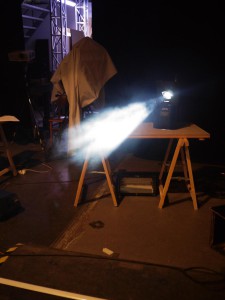
3.6 Moving heads
(Intelligent lights, automated lighting, moving lights)
In the 1980’s, many lighting manufacturers started experimenting with ways of moving the light. A moving mirror at a par can was one of the first. This way of moving the light was developed as a range of lights called scans. The Golden Scan of Clay Paky and the Cyberlight of High End are the most known. The Cyberlights have been used till in the first decade of this century. They had an amazing output and great gobo’s.
The essential feature of automatic lights is the fact that they can move. They can execute a certain amount of inclination degrees (TILT) and certain number of rotation degrees (PAN). Movable lights are usually equipped with an integrated (removable) range of gobos, filters and mirrors. They are connected to a 240V power source of electrical energy; all control is via DMX interface.
Structurally very complicated mechanic allows real-time changes of a range of parameters – the size of the beam of light, sharpness, color and directing of the light beam in the X-axis (pan) and Y (tilt). They can be mounted with lamps (most often), but also with bulbs or LEDs. Different types can contain other modules as gobos, rotating gobos, etc. Since all parameters are controlled by a mechanical motor, moving heads are noisy to a considerable extent, which is a handicap in the drama theatre.

A fixture of moving head type.
Moving heads are destined for dynamics. When the location is well chosen, their light beam reaches almost any place. They might be equipped with rotation gobos, which can divide a light beam into three and focused on a larger area in such a way. This effect is used for induction of shadows of trees or flowing water. When used with steam or smoke, light trails can be drawn in the space, which is commonly used at concerts. Many intelligent lights can mix colors up to theoretically unlimited variety, although the actual use is limited by many factors. Lighting consoles can adjust the colors with setting of shade and saturation. Dichroic filters are used in many intelligent lights and are made of heatproof glass that is covered by a thin layer of material. They allow some frequencies, but instead of absorbing other, they reflect them.
The other way of moving the light was to move the whole fixture or the head in a yoke. These were called yoke spots. These kind of spots have a wider range then the scans with a moving mirror.
Yoke spots are more difficult to control. With the pan and tilt and the fact that moving lights can turn around more than 360 degrees in pan you can reach any position on stage in different ways. Moving the pan right or moving the pan left are already two ways. Yokespots are nowadays used more.
There are two types of movingheads :
A) spot (PC optics, narrower, sharper light beam) and
B) wash (Fresnel optics, wider, more diffused light beam).
Moving heads can be further divided in several ways.
- those that have a movable mirror in front of a solid body.
- those where the entire lamp or head moves with the help of a motor.
Or
- hard edged light – it has a similar optics as the traditional profile reflector, it can be used with gobo.
- wash – it uses similar optics as PC and Fresnel for creation of large color surface.
There are several ways of how the device can change its color, depending on time delay as it can be rather rapid or gradual. For rapid changes, a disc with glass filter with two colors inside is used that can be inserted into the light beam with a remote control or a color scroller can carry out a similar change from the outside.
These devices can perform a continuous change of colors using glass filters of two colors in combination of three basic colors – cyan, magenta, yellow (CMY).
WashBeam is a hybrid type of automatic lights and so might behave as both the types. A lighting designer can use the same device to produce different effect and thus save not only time, but resources as well.
DigitalSpot is an original combination of projection technologies and intelligent lights. For instance DigitalSpot 7100 DT contains digital projector and two fields of high-performance RGBW LED diodes. The projector has the luminosity of 7000 ANSI lumen and each LED field contains 48 powerful LED diodes of radiance angle of 25°. The device is controlled by a computer, which is a part of its controlling unit and offers basic functions of a media server as video and image layers, masking etc. with a library of digital gobo images and videos with a possibility of creating them.

WASH head Vari-lite VL3


4. Effects lights
A category of lights with high and fast real-time on dynamic of changes in focus, color, shape, sharpness, etc.. It is used for lighting effects either in the theater or events. ( types: Scanners / Scans, blinders, strobes / strobe, movingheads etc..)
Some types of light sources according to the mode of common usage:
4.1 Followspot
A followspot is a type of an instrument that is constructionally very similar to a profile – it has at least one movable lens, which enables to focus the light beam, its size is relatively small because it is used for following actors from a distance. By the default, it is fixed with an iris diaphragm, and optionally with a set of telescopic colored glasses or its own dimmer. The source may be a halogen bulb, but it’s a discharge lamp more frequently (for the followspot, large luminosity is often needed, it is used to cast additional light onto the soloists in the surrounding light situation).
A followspot is then an instrument placed on a tripod in a suitable position, manipulated manually by a stage lighting worker, intended for direct spot lighting of a moving actor in the case when it is necessary to highlight him in contrast to the surrounding light atmosphere.

A fixture of the followspot type.

Korrigan Follow Spot Kit
4.2 Pinspot
– the name derives from a very narrow light beam (3 to 5 °), the source is a low voltage lamp (characterized by colder light quality).


5. Sources of light
Until now, we explained what kind of light the different fixtures make with different reflectors and mirrors. But there are other properties that influence the light as well. As much as conventional lights and moving lights concerns, there are 3 controllable properties of light: the quantity of light (the number of sources of light or the amount of light you need), the color of light, the distribution of light (the way which light of any quantity is spread and distributed over the acting area).
Since the 80’s, the majority of conventional light used Tungsten light sources. The color of these light sources is a kind of warm, more yellow or red than there is blue. To dim these light sources, there are separate dimmers needed. When dimmed, their color temperature gets lower. That means the color of the light gets warmer, or more red. Light designers do play with this.
This also means that the color of filters also changes when dimmed.
Most moving lights were using discharge light sources. Though there is a lot of moving lights with a tungsten light source. The good thing about discharge light sources is that they produce less heat. The bad thing is that they can be dimmed like a tungsten light source. Shutters are needed for diming discharge light. This is a kind of an iris in the unsharp part of the lens system. This means that the color temperature does not change when you dim them. The color temperature of a discharge light source varies between the 5000 and 7000 Kelvin. This means that there is a lot of blue in the light. It looks a lot like normal daylight.
Most moving lights have a correction filter called CTO (change to orange) to imitate the color temperature of a tungsten light source. So if you use them together, you can adapt the colors. Of course you can change the color temperature of a tungsten light source with a CTB filter (change to blue), but that is more work.
Since the upcoming of the LED as a light source, more and more moving lights have a LED light sources. The transition in the conventional lights from tungsten to LED is happening more slowly. Only for par cans, the change was fast, but mostly not in theatre lighting. Though many brands offer a LED to be in Pc’s, Fresnels and profiles, they are not used as much yet. Also tungsten par cans are still used a lot.
A LED light source also doesn’t dim in the same way as a tungsten source does.
Most of the fixtures use bulbs. Light is thus generated by heating a tungsten filament in a bulb from quartz glass being filled with a halogen gas. When a thread is under voltage, wolfram heats up and emits light. The quality of light very much depends on strength of voltage, released into the bulb. Thus it is technically rather easy to control the level of electric current going through the filament. And it’s possible to manipulate the desired color atmosphere on the stage by allowing more or less electrical current into the circuit as if only a small amount is let into the bulb, the white color that will be emitted in any level of the current will contain different color components that together create the white. Human mind perceive the light of smaller current as warmer as its white color contains more of red and less of the blue color. The stronger the current, the colder would seem the white light to a viewer’s eyes as there would be more blue and less red color.
Artificial light sources
The list of light sources could start by the fire and candles. Nowadays in lighting technologies, we’re mostly using the electric light sources. That is the bulb, fluorescent, discharge lamp and latest LED (Light Emitting Diode). They are different in the regard of emitting different spectrum of visible light and non-visible light which is transformed to the visible spectrum. They produce different types of wavelengths of the color spectrum. This is caused by the principles of their functionality and also by their chemical base. In the stage lighting (and film as well), there are used these types of artificial lighting sources:
A tungsten bulb works on the principle of heating of a thin wire, usually of wolfram, by electrical current that flows through it. It contains almost the entire spectrum of visible light. The most distinctive are the wavelengths of yellow and red of the spectrum, blue and ultraviolet ones are completely absent. A bulb remains a cheap source, but its disadvantage is high heating value as the majority of energy is emitted in the form of infrared radiation. It’s used in old historical spotlights, chandeliers, small lamps etc.
A halogen bulb is of a similar construction and functioning as a common bulb (tungsteen bulb) with a difference in the content filling gas, which contains admixtures of halogen gases as bromine, chlorine, fluorine, iodine and possibly others. Used in: in some cases as tungsten bulbs and in PC, Fresnel, Profiles, PARs, some type of the fixtures etc.
A fluorescent light source is used in schools, offices, factories. In comparison with ordinary bulbs, it doesn’t emit heat and so it produces cold white light. Light spectrum of a fluorescent lamp is rather deformed as it lacks especially sections of red and blue violet spectrum, those that are the most strong in the natural light. There are these types of fluorescent lamps: linear tubes, energy saving lamps, compact fluorescent and so on. Used in: the specific lighting luminaries, table lamps…
A discharge light source is based on the gas heated by the electrical current in a transparent container. The current makes the gas glowing, creating strong intensive and stable light being closer to the cold colors (cool white). There is a lot of different types (high-pressure, mercur vapor, sodium vapor, ceramic and so on). The advantage is not only strong light but also big power efficiency (more than bulbs and fluorescent, less or similar as LED). The disadvantage is that they’re not dimmable (in some cases only to 70%) so the dimming of this sources is done by mechanical dimmers (barn doors, shutters etc.). Used in: Mostly in the fixtures as moving heads, scanners, followspots, strobo…
LED (Light Emitting Diode) works on the principle of electroluminescence of semiconductor materials. Light emerges on a basis of transitions of electrons from higher energetic levels into lower ones. Here, rather large efficiency is reached in transformation of electrical energy into the light. LEDs are rather expensive, but with long duration and have high chromatic temperature so there is a large portion of wavelengths from the blue section of the spectrum. Used in: RGB mixing fixture (PARs, Strips or Bars…), moving heads, and in these days, it’s used as substitution for a whole range of the lighting instruments.

Colo temperature comparison.

Sources comparison.

Tungsten filament in an incandescent light.

LED.

Fluorescent vs. incandescent bulbs.