3. Perception
3. Perception
3.1 How do we see?
Light influences the perception of space considerably.




Light as we know it is just a small part of a greater phenomenon known as the Electromagnetic spectrum. For the human eye, the visible spectrum is between 400 nanometers (nm), which we perceive as the violet color, to 700 nm, which we perceive as red. Each color in the visible spectrum conforms to a wavelength of the spectrum.
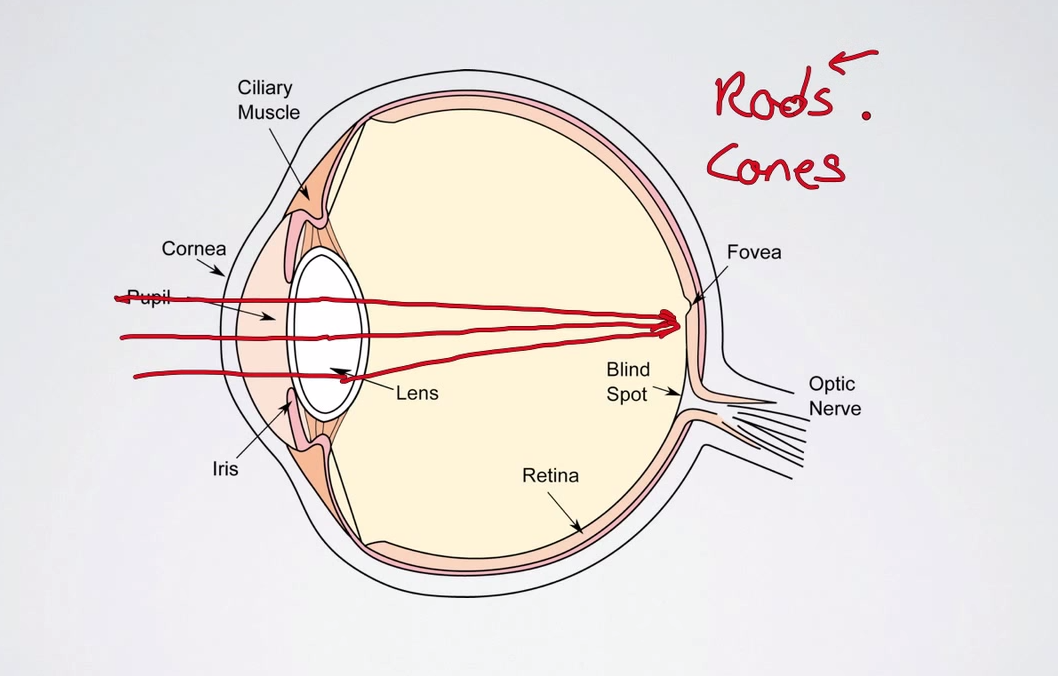
So how do our eyes perceive red, yellow, green or any other color? Is it just by seeing a wavelength? In the back of our eyes, in the retina, we have photosensitive cells. These cells are named rods or cones. The rods are responsible for sensing light intensity and the cones for distinguishing a color.
There are three sets of different cones in the retina and they perceive the wavelengths red, blue and green. If we see the color yellow then the eye receives the equal stimulation of the red and green receptors. Therefore we see yellow.
The human eye is adapted to seeing things under the light of varying degrees of brightness. Sunlight, moonlight or even starlight, the human eye can change the size of the pupil to adjust to the brightness that is available at that moment. However, not just the pupil alone governs the functioning of the eye. Certain other visual systems control the way the eye works. And two systems in particular are responsible for this so called ‘color fade’ in the evenings and nights.
These two systems (aka two photoreceptors in retinas) are called the cones (color receptors) and rods (light receptors). The cones work best under bright light, can see color vividly and can focus on fine details effectively. The rods on the other hand are sensitive to light and can only see light and dark. They cannot see any colors or differentiate between them. The rods would need to borrow light from the other parts of the eye to adjust vision and so, cannot focus on fine details like the cones.
Now, try to understand what exactly happens when the lights dim and the colors start fading. The cones respond better to yellowish light and so find it difficult to function under the receding light, passing on the responsibility of vision to the rods.
Colors are not an attribute of things as such, but they are recognized in our brains, though a color is based on a feature of a given thing. The things in the world don’t have its own color, but one of their attributes is to absorb some wavelengths while reflect others. Black object absorbs the entire spectrum, while white one reflect all of it. There is no color, when there is no spectator. All the things are actually black and white and the color of things is a result of reflection of light in combination with the composition of the surface. Therefore objects can have different colors when lit by a specific type of light.
Some retinal cones are sensible to longer waves of light radiation, so red stimulus is perceived, while others are sensible to other lengths. The final shade colors are determined from the pool of perceived stimuli on cones and overall distribution of them. The human eye is trichromatic that means that this system is based on recognition of three types of stimuli according to the length of the waves. In accordance with overall distribution, the resulting image is roughly of the same proportions as the distribution of stimuli at the cones.
Receptors in the human eye are sensitive to the light of wavelength between 380 to 780 nm. If only one type of receptors is irritated, the perception of a basic color is achieved. Irritation of more receptors cause the perception to see shades of colors or white in dependency on overall distribution of impulses in the eye. If there is none irritation whatsoever, black is perceived.
The sensitivity of the eye towards all the colors isn’t equal, the retina can adjust itself to higher or lower levels of luminosity. The sensitivity is maximal for the color of wavelength of 555 nm that is yellow green and corresponds to the center of visible color spectrum and to the fact that the sun emits most of the energy at this wavelength of 550 nm. When the eye is adapted to dark as happens in the night, the sensitivity is shifted and colors differ only by their brightness and most bright seem to be wavelength of 500 nm, which corresponds to blue green color.
Rods in the eye detect the perception of intensity of light, i.e. brightness and luminosity and so providing further indication and dimension to the sight.
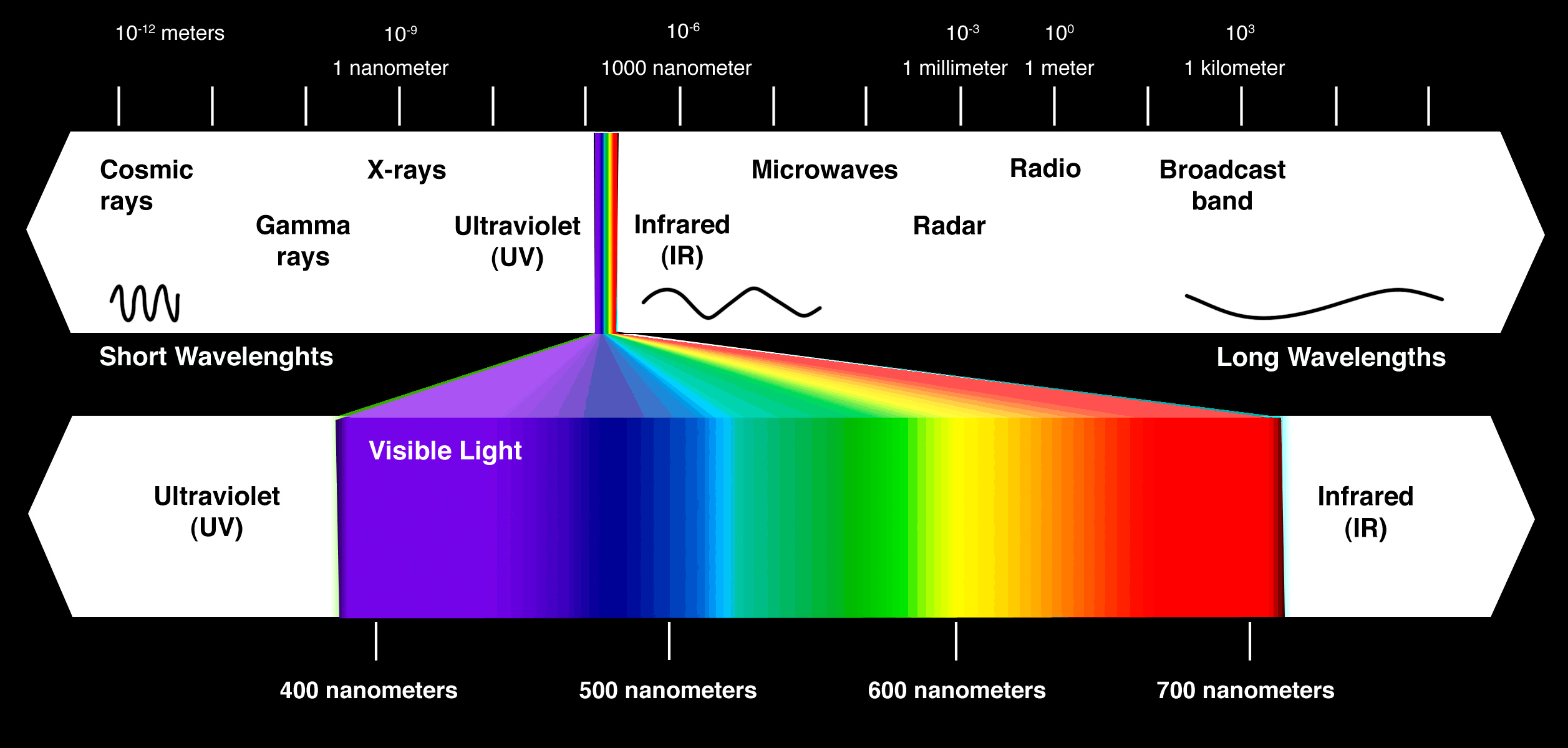
Electromagnetic spectrum.