
5. Beam
5. Beam
Natural light is something that we are accustomed to and we take it for granted that there is usually one strong source of light that casts light from above and scattered light from the sky and only minor fraction of the light is reflected from bright objects around. Its quality is composed of all the wavelengths of the spectrum and therefore is perceived as being white. That means that the natural angle of lighting is from above the line of sight, which is often reproduced in interiors as well. Similarly, concerning the quality, though qualities change, it is white light as well. We are used to the environment, where the predominant angle of light comes from above and is white. That shapes usual perception of faces, where the natural light creates shadows below nose and chin. Reversal of this situation happens, when a flashlight cast light onto the face from below, as any child would remember, and cast shadows create an unusual face, the scary one. And between these two examples, there lies a variety of possibilities.
Shadows that are cast by the sun have sharp edges, because the rays fall from large distance, similar to the light from a spot light lantern. When there are clouds, the light is dispersed, so the shadows are rather deformed into soft edges or they might be even erased.
A shadow is absence of all or some of light and is dependent on the quality of light. A shadow can be described in terms of size and shape. The more sources of light are distributed in the space, the more shadows come into existence.
Creating a cue, reproducing the natural light, manipulating with the spectators’ sight requires a certain level of understanding of natural appearance of things, in a certain sense, it requires not to accept simply the things as they are, but to be able to imagine them in the context of possibilities, of what they might be, if the basic axes were shifted. To reproduce daylight, there is a basic necessity of having the sources of light above the line of sight as it is in natural conditions and of producing some kind of white light. If the art intention demands destruction of spectators’ attention, there are many techniques that can be applied against the basic principles of natural ambiance. But what are its essentials?
5.1 Intensity
Intensity is understood as a rate of light in a given moment. It is one of the basic descriptive elements that is available in the work with light. The most important attribute of intensity is the possibility of highlighting the thing from the dark. In such a manner, the attention of a spectator can be directed. How much of light covers the area? How much of light is reflected from objects? How much of light penetrates the eye of a spectator? This is measured in Luxes that state intensity of light in a given moment. Another unit Lumen expresses the entire output of light from the source.
The light beam from the majority of sources expands with the larger distance from the source, while its intensity is gradually reduced and thus the level of intensity would be declining proportionally to the distance. The human eye can adapt to the range of intensity between 100 000 to 0,00005 Lux.
The sight adapts to the level of medium intensity of the objects in the focus, which is a bit different issue than the general level of the visual field.
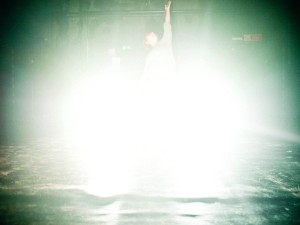
Dazzling is a large difference in intensity of lighting, where there are areas of distinctly different intensity that often happens when looking into the brights while driving or when a strong reflection from materials. It may happen in theater as well when a slit between filters and the body of source of light opens.
The sight can capture petty details in the middle of the visual field and quick movement at the periphery. If the sight is not disturbed by anything else, it focuses the attention to the point, which is the brightest one in the visual field. Practically, it is essential for determining the attention of the spectator to control the intensity of light sources.
The change in intensity of light at the stage can be understood as a change in time, place or centre of action. However, if there occur many of such changes without clear relation to the development of the plot in scene, such a relation would be ignored as proved to be a wrong clue in previous cases for the spectator’s mind. It is possible to uses changes in intensity to indicate the relation of one area towards the other and so it can create boundaries of areas and delimitate them in such a way. The essential decision that lies ahead in lighting design is how many separate areas and shapes are to be lit within a cue.
Colored light is created by filtering of unwanted wavelengths. All the filters considerably lower the intensity of light. Red filters absorb not only all but the red light of the visible spectrum, but infrared wavelengths as well.

Intensity of the beam decreases toward edges.


Beam Angle is a measure of the conical width of light from a light source and is measured in degrees. The smaller the number of degrees the narrower the beam and the larger the degrees the wider the beam.
The term focus is a tool for description of which area or areas are to be lit and from which direction.
It contains two features:
1. Angle of incidence
2. Throw

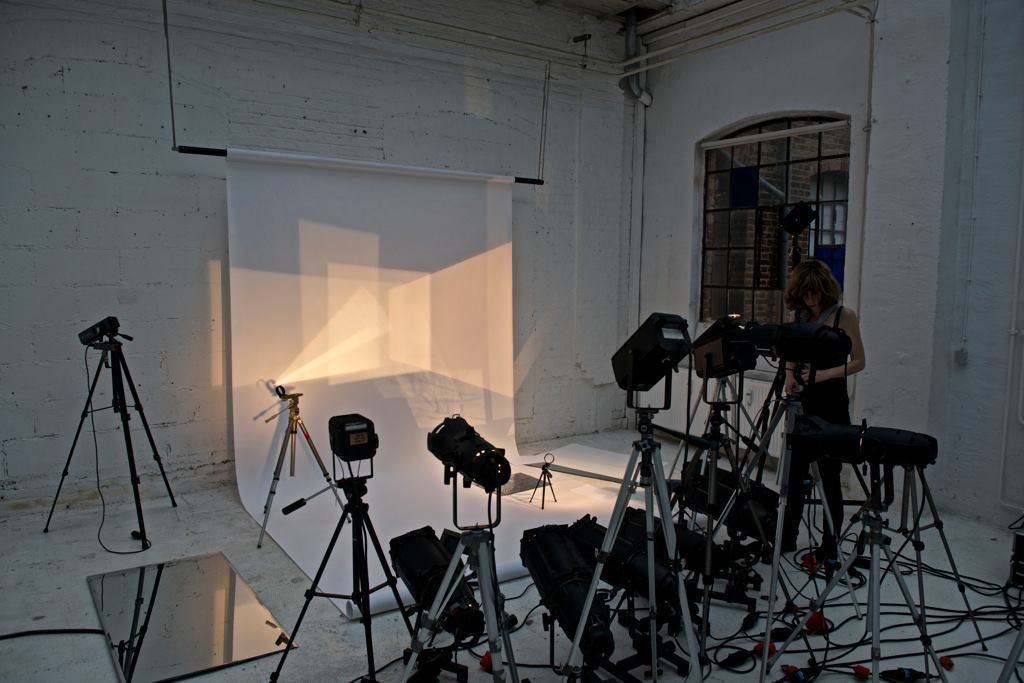


5.2 Angle of incidence
Angle of incidence influences the perception of objects within or outside the beam. It describes the relation between direction, where the light comes from and direction, where the spectators watch from.
The shadows form their shape according to the angle of incidence and the position of the viewer. Naturally, given the limitations of available places in the space, a key factor is the decision, where the sources of light should be hanged.
The basic position for the determination of the angle o incidence is the position of an actor, who faces frontally the audience. There are two main angles that are in play:
- Elevation angle is measured from the level of the stage
- Angle of actor that he needs for turning from the initial position towards the audience to the position of facing directly the lights.

5.3 Throw
It concerns the source of light and the trail, in which it travels throughout the area / the distance between source of light and its destination.
Throw – how to calculate?
S = MF x D
“S” is the size of pool of light.
“D” is the distance of the fixture from the lighting area.
“MF” is the multiplication factor provided by the manufacturer.

6. Focusing
IDEAL SPACE HAS INFINITE NUMBER OF HANGING POINTS
In comparison with the common English meaning of “focus”, this word refers to the process (or state) of settings of instruments (the size of the lighting beam, sharpness, direction, filtering, fixation with Gobe or Iris). To “focus” means to prepare the lighting instruments into the final state as they will be used in the scene.
Such step means directing the light beam towards the desired location with desired intensity, to cast light onto what is wanted to be visible, while leaving what is to be hidden in the shadows. The work is different with intelligent lights that are highly adjustable and with the convenient ones that rely on manual settings.
Therefore focusing concern three main tasks:
- aiming the fixture into the position so the light is cast onto the desired area and things
- adjustment of the quality of light and size of the beam so desired area and things is within the spread of the light beam, but not too wide to cover too large surface or to cast light into spectators’ eyes.
- Shaping the beam
As the intensity of light decreases with increasing distance, it is a factor of consideration as well.
There is a variety of approaches to the procedure and sometimes it isn’t a reflected process, but just a custom, which includes relation at the workplace as happens only at very small venues that would concern only one person. A lighting designer who is in charge of providing instruction to the technicians is usually at the stage, where he can be at the positions where he can check, whether the entire figure is within the light beam, when he turns away from the source of light and examine his shadow. Simultaneously, he should have the whole picture in mind to reflect the context.
Communication might take place over a long distance and so clear orders are an advantage as it is rather probable that simultaneously there isn’t much time for correcting errors.
If the lighting is fixed to a certain angle, how to get an actor to be there? One possible answer is that first the beam has a certain range and secondly the stage is usually divided into areas, which helps to maintain consistency. Distinct areas need to overlap quite a bit as actors passing through a dark spot cause an unwanted effect of attracting too much attention. Overlapping is almost necessary as the sources usually shed the light with highest intensity at the middle line of the beam while the intensity is being reduced towards the edge. If the lights have the same value, there is no increase in value at their joint area, whereas if there is one with higher value, it overrides the weaker one. To create an even coverage of the area that wouldn’t disturb the uniformity, the intensities of two adjacent light has to be joint.


Light with stronger intensity overrides the one with smaller intesity.

Citizen Kane, bad focusing might be intentional.

Out of the beam.

The figure remains within the beam.

What can be sn artistic intent in dance could be a failure in drama.
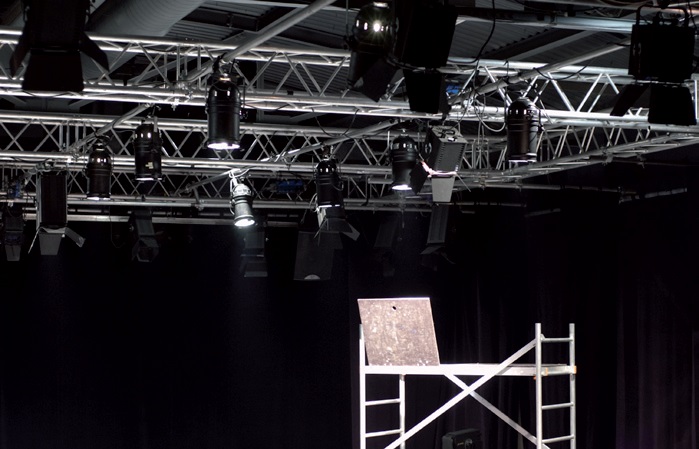
A truss structure is optimal for an almost unlimited number of hanging positions; using aluminum rods and couplers, a desired position of a luminaire can then be selected with a margin of of a few centimeters (Ponec Theater in Prague)positions; using aluminum rods and couplers, a desired position of a luminaire can then be selected with a margin of of a few centimeters (Ponec Theater in Prague)
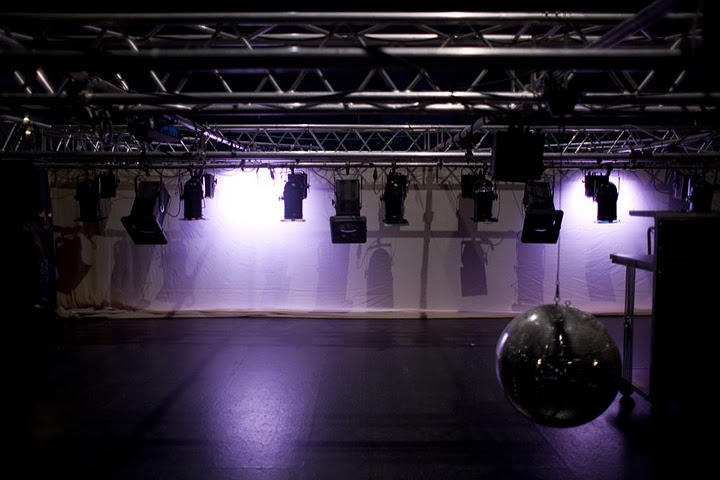
Lowered hanging points.
The real space has large limitations, although that might be an advantage in theater, where the hanging positions are more or less given.
Variables of the space have a large impact on possibilities of lighting as hanging points might be created anywhere, if there are bars that can serve as hanging points or the hanging point can be fixed as well as the focus, color and patch. Each space has a particual setting of these parameters. The infrastructure opens some doors while closing the other.
In a large theater, a lighting designer is a member of a creative team, which as limits as guides his work. The lighting technicians are there indispensable. On one hand, there are settings that are very temporary, practically only for the duration of the performance as concerts or touring performance and on the other hand, there can be stable, long term infrastructure available. To the stability, the dimension of size that is to be considered as small drama theater can merge the job of a lighting designer with other, while there can be large auxiliary staff in bombastic events.

Vertically mobile ceiling grid of truss construction enables to fix spotlights.