
5. Touring
5. Touring
Transfer of original lighting design
It is hard to generalize across the time and space about the art. It is no different in the lighting design of live events (theater, concerts and other events with stage lighting – galas, fashion shows etc.). Lighting design is dependent as an artistic and technical component on the vision of the director and set designer of the given performance or event, and also on the technical possibilities of the space. It follows from it that everything is connected to everything, plus the range of possible variations and combinations is so wide that it is impossible to give a strict, specific manual on how to manage the transfer. However, some rules, or connections, if you will, can be formulated about the laws that are valid almost every time. First, it is necessary to have a look at the points of departure at the very basis.
Any permanent theater building all over the world has its system of stage lighting, which is fixed, unalterable for the most part. But it is usually possible to have spotlights or instruments added onto other positions on the stage as needed, to which lighting units can be safely fixed and connected. However, there are theatrical spaces, which stage lighting is very variable, i.e. there is a system available that is ready to be essentially adjusted according to a request or instructions of a given performance from the structure through connection to control. Therefore in any theater space, there are, say, several parts of the lighting system that are more or less similar but never the same – and that is just the “rub”. These parts can be divided as follows:
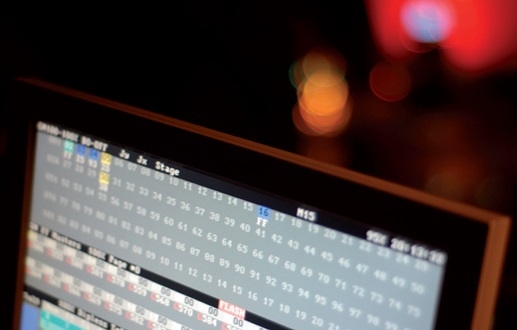
Control of the lights in another space proves abilities of any lighting designer; the principles, on which contemporary lighting consoles operate, are similar, yet each brand has its own peculiarities; work on a console in a different environment (mostly under time pressure and often without the operator of the console) thus examine experience and knowledge (a console of the firm LT).
- power supply issue
- control issue
- positions issue
- material equipment issue
5.1 Power supply issue
The part of the power supply concerns a switchgear or where there is a connection to a power source – it may be an electrical network or (in exterior spaces) mobile generator. The power part of the stage lighting is also a part of it, which means in particular dimmers, switching of power supply circuits (unregulated circuits controlled by a lighting console operator and additional lighting units, which cannot be controlled by dimmers, e.g. moving heads, LED instruments, hazers, foggers, etc. .), and circuits supplying other related technologies or other parts of the lighting (e.g. lighting of the auditorium and adjacent areas – foyer, cloak rooms, staircases, working lights used in the preparations, but also equally important emergency lighting).
5.2 Control issue
The control area is the space from where the power supply part is managed and controlled. In theater buildings, it is the booth, or cabin, usually located behind the auditorium (even today it is possible to find functional rooms of cabins under the stage, on the stage in the proscenium arch, etc..), in the case of theatrical space outside the theater building’s mostly a “live post” – a place where there is a lighting control desk or another auxiliary panel to control the other elements. It should be noted that the lighting control is often next to the sound booth or both are located in one place. In small venues, lighting and sound is often controlled by one technician, while there may be multiple lighting and sound technicians in large venues during the preparations and the performance.
5.3 Position issue
The position part is that part of the stage lighting systems, which determines the position, the location where the area contains instruments and other lighting or technical devices. It determines the additional options of connection for added lighting technology at the same time. The position part has several functional subsections that should be present in any area. It particularly concerns the positions for: front lighting (instruments placed in front of the auditorium or in front of the stage – the abbreviation FOH ( front of the house) became usual, i.e. everything that is in front of the stage, curtain, play area), side lighting (instruments placed at the flank and sides of the stage), back lighting (instruments at the rear of the stage used for backlighting), lighting from above (lights located directly above the acting area for the creation of so-called down lighting) and light from the below or from the level of the floor of the stage.
5.4 Material issue
The aforementioned is a base for any lighting of a stage. A part of material equipment contains all things in addition to the range of instruments and lights installed in a fixed way in the given space. For variable systems, it is a list of all that is available. Therefore they are the lighting devices that are being added according to the need of the vision of the director or set designer. And this also includes the extension or communication cables, filters for coloring instruments and various other devices related to stage lighting (hooks, hanging tools, tripods, stands, security cables, data converters and many others).


