
Case studies
Case studies
Examples of applications
The following text will be devoted to the presentation of these laws and their variation in terms of some specific situations.
1. Orbis Pictus
The case study is devoted to the concept of light dance performance called Orbis Pictus
The Orbis Pictus was the outcome of collaboration between two experienced choreographers and dancers, Michal Záhora and Lenka Bartůňková (troupe of the dance theater NANOHACH). The theme of this choreography blends certain metaphysics, certain timelessness with ingredients of mythological paintings. Initial scenic intention of choreographers was to create a “frame” that is a specific, real frame, as a scenic element, which could be easily and silently moved around the stage. The frame would serve as a window, into which would be concentrated the focus of some scenes. Thus there would be emerging at least two basic emotional levels: moving images in the frame and “free” choreography in the space around it. At the same time, a certain displacement angle of the viewer would be achieved by turning the frame, and therefore relativization of “what is given”, in comparison with “from what angle we look at things.” This is the way how the choreographers imagined that.
Light frame
A light frame is here a designation for the light lines that are capable of dividing the space in a variable way and of delimitating it. Highlighting the path of rays of light (beam of light) is an effect that can be observed for instance somewhere in a barn, where light penetrates through small holes in the roof and is captured on the small particles of dust swirling in the air. This creates beams of light, light cones. It is actually a natural light illusion. Lines give an impression of being quite material, they exist, are in reach, but are intangible. What more can a lighting designer ask as a creator of illusion and unreality. The same principle, i.e. capturing light on invisible particles, which are dispersed in the air, can be applied with the use of a hazer (or a fog machine, a device that can create fog). A hazer is a device, through which one can create gentle mist in the space. To have this haze dispersed evenly throughout the space, it’s also possible to use a small fan, located adjacent to a hazer, but it is not always necessary. Once the space is slightly hazy, light rays are made more visible. This leads to the formation of lighting architecture of space.
In this case, to create thin light lines, profile lights were used. The smaller the angle of light, the better, because the focus forms a small, but significant light beam. This means that in the best case would be to choose profile with optics 24 ° and less. However, these are not so common in a normal theater, so for this performance, there the standard profiles with a range of light cone of 36 ° were used here. For the implementation, a plan was drawn , where a shape was depicted of composition of light lines. The profiles were hung vertically as wash and small rectangles of the size of a palm were created with the help of shutters. An iris diaphragm could be used as well – a device that is inserted into a lighting device and can reduce, close the light beam at will, but that makes the light output decreased. The lights were so arranged that each one was individually plugged in, so that each was separate and the shape of a “light house” could be arbitrarily decomposed and transformed. There could be for instance only two or four vertical light pillars or diagonal lines outlined by light. This simple principle allows variable transformation of the space. Specific shapes and their combination were chosen rather intuitively during rehearsals or were chosen at the request of choreographers.
Division of the space by each light pillars at the same time also influenced the choreography itself, especially the choice of the spatial distribution of motion. Here then, there was almost perfect balance of power, where the creation of lighting design inspired movement components of the performance and vice versa. Thus, this is how a lighting design is to be developed in an ideal case: collaboration between the choreographer and lighting designer when meaning of lights and their moods are gradually discovered and are created simultaneously with the choreography.
Light gate
Another scenic and significant element was a “light gate”. The idea of creating the light gate came from the need to anchor the scene with some fixed, but magic point and simultaneously to divide it into the “present” in the front and the “mysterious” in the back. A gate, or better “light wall”, was therefore placed in the center of the rear stage to gave an impression of dominance, as an entrance to the “other space”. The light wall consisted of a series of five profiled beams (zoom 25-50 °), which were hanged in a row next to each other and perpendicular to bottom. The focus on the stage floor created a light trail as a line 2.5 m long and approximately 15 cm wide. With the help of scattered smoke of a hazer, there was a semi transparent light wall that dancers could walk through or form images in the background behind it. Thus a gently misty, mysterious image was reached. At the front side, profile lights were covered with a short piece of black cloth, i.e. border. This is used when it is not appropriate that the viewer see a light source. If the source is not covered, it appears as the first at the pan of the light. That catches the viewer’s attention and disrupts the effect of materialization of the actual “light wall”.
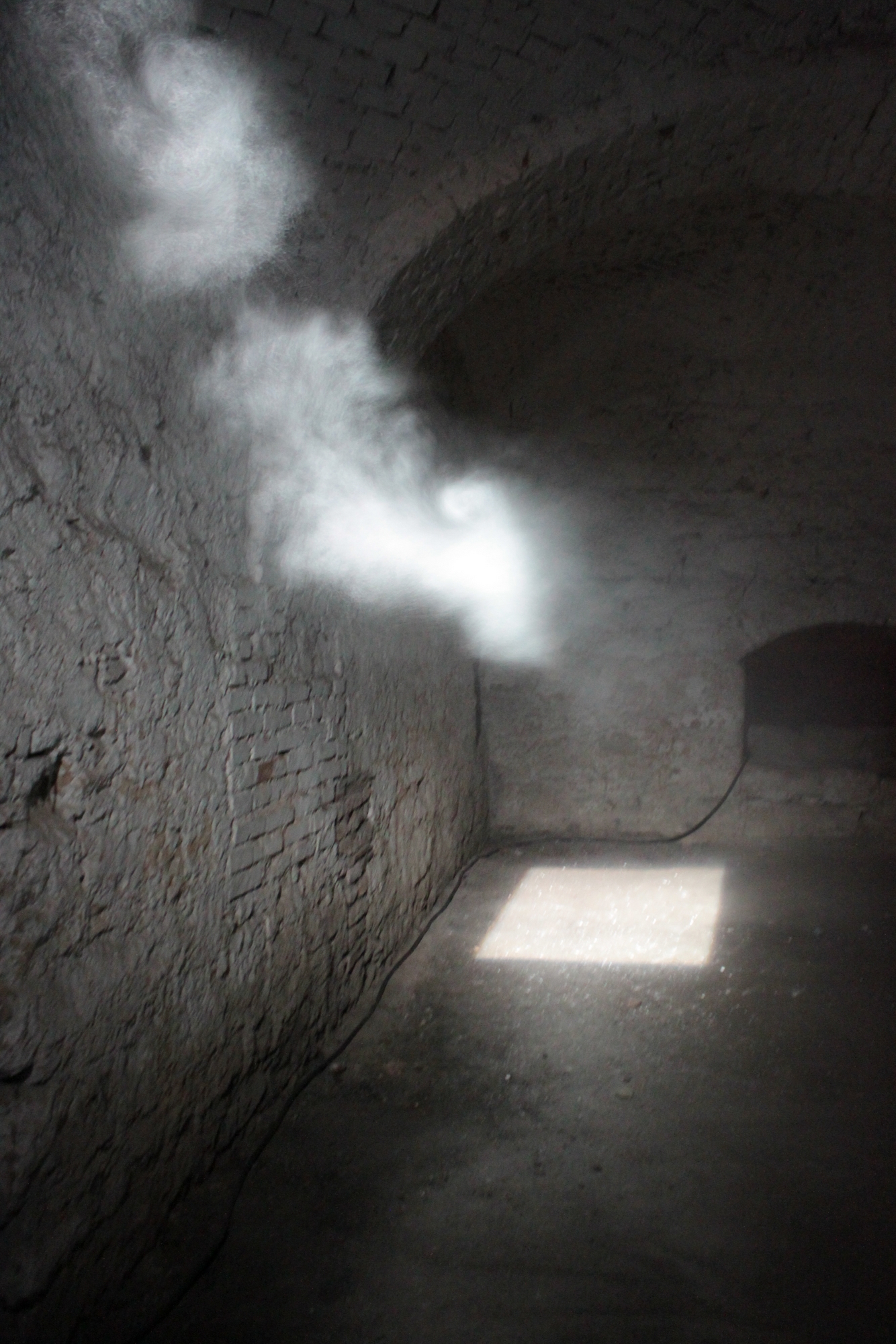
Highlighting the path of rays of light (beam of light) is an effect that can be observed e.g. somewhere in a barn, where light penetrates through small holes in the roof and is captured on the small particles of dust swirling in the air. This creates beams of light, light cones.
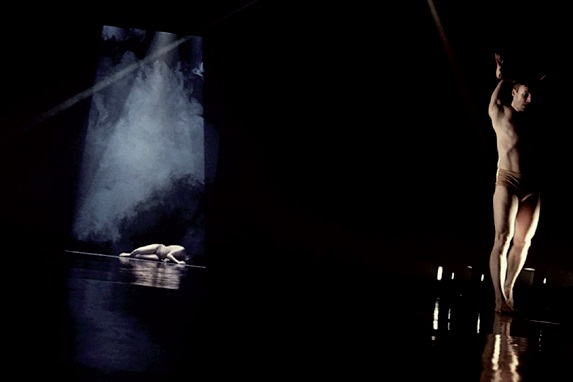
Performance Orbis Pictus (Photo: Jan Komárek)
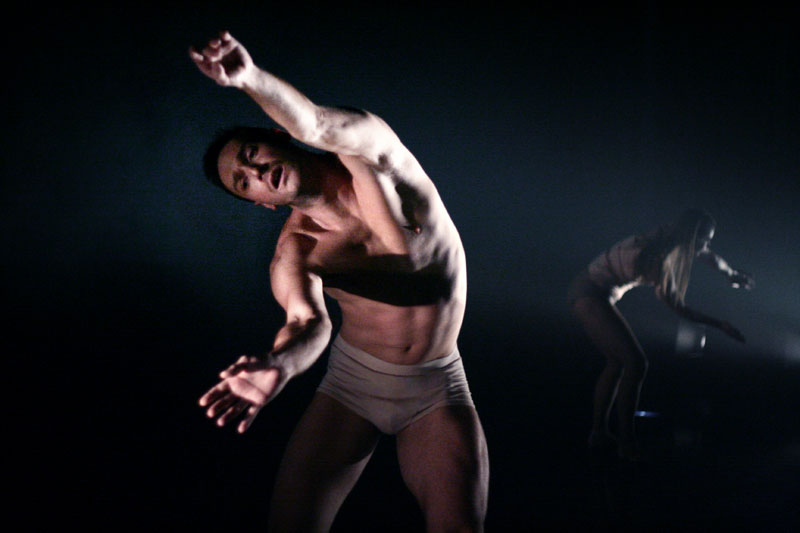
Orbis pictus, photo Anna Šebelková
The idea to create light wall subsequently influenced the choreography and the story told in the performance. It became so one of those “frames”, in which the image and movement could be focused, it became the starting point and the doors, through which dancers could go into “infinity”. To keep the space mysterious and “endless” as much as possible, a path in the middle was created that led from the light wall through the middle of the stage towards the spectators. This path was created simply with few upright focused lights with a narrow light beam (PAR 64 CP61), which do not have such large scattering of light and which edges are soft, slightly blurred, organic. The dancers slowly moved along this middle path and they were also followed by a spot light by individual PAR’s so that once they passed through the light, it was gradually fading away while another light was being turned on. Thus isolation of the scene from the surrounding space of the stage was achieved. It is possible to do this “walking” lighting either manually or to program it sensitively. The pan of lights has to be soft and well-timed in any case so lights themselves don’t cause distraction from the actual action of dancers.
The viewer shouldn’t actually perceive the lights and their movement at all. The already mentioned use of a hazer therefore allowed the light to materialize. It depends of course also on the amount of used mist. The best is when the operator of the performance himself has the control over hazer switching and it turns on and off according to his needs. The fog stays in the air only for a certain amount of time before it dissipates and disappears, and it is therefore sometimes necessary to supplement it. To fulfill the requirement that the viewer shouldn’t see how the fog penetrates onto the stage, there can be used the moments when the scene is darker, and also the moments when the music and sound is louder, because the hazer gives hissing sound when turned on. It is therefore necessary to handle the hazer similarly as the lights. It is one of the components of “visual magic”. The columns of light can be used by dancers as light wash when they enter them. Since the columns are about the size of a palm, dancers can turn gently in them and so gradually illuminate parts of their bodies. Another possibility is not to enter into the light, but only approach it.
Body, particularly the skin, would be then lit by reflected light that has a fragile and mysterious impact, as for instance happens at the Rembrandt’s paintings. If the dancer put his hand into the light, he can direct the reflection of light himself by turning it. These are all elements that enrich the possibilities of lighting range and it is good that the dancers have the opportunity of experimenting in the lights. Because one component inspires the other, light inspires the choreography and vice versa.
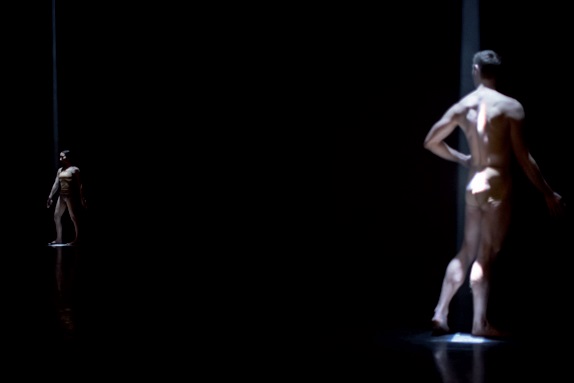
Dancers used the narrow light beams for a play with light and shadow, when they could enter into the light, be lit only partially, or by a reflection of light (photo Vojta Brtnický)
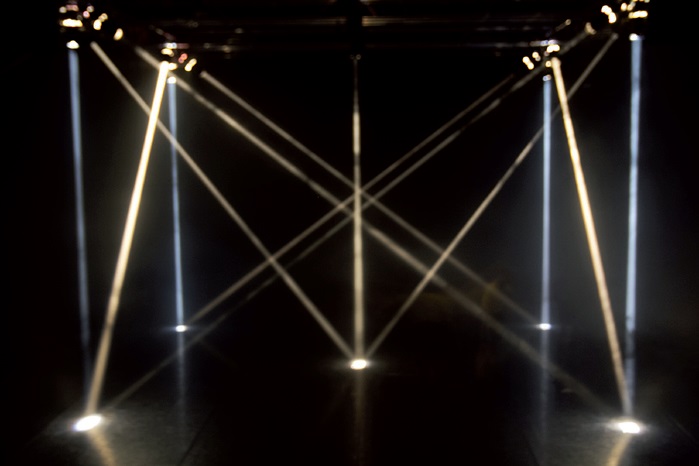
House of light – light architecture in space – a fragile construction of a house, created by narrow light beams of profile units, the beam is highlighted by the use of a hazer. (Photo: Jan Komárek)
Dematerialization of the space
In most cases, the scene is set in a classic proscenium stage, which is simply a black box without the front wall, which the viewer looks into. In this black box, a lighting designer should be able to conjure up different spaces and lighting of landscape so that the spectator could forget about the walls around.
In the case of choreography of Orbis Pictus, the conditions were actually almost ideal. Dancers moved half naked in the black space, so their pale skin reflected light well. It was possible to use less light intensity, and thus to reveal the space as little as possible. The dancers sometimes were moving around the whole space, and therefore it was not always possible to use spot lights all the time. It was possible to use, but it wasn’t the case here, a usual effect when the whole surface of the stage is covered with light from several rows of PAR’s CP62 (wide lens) that are slightly back focused. Here, in relation to the theme of the choreography, it was really inconvenient to unveil the space much and was better to “gently coat”, not illuminate the dancers with light directly. There are not so many ways of how to illuminate the whole scene. It is possible, in relation to the nature of the project, to use for instance 1 000W floods or opened PC and Fresnel lights as floods, respectively the mentioned rows of PAR’s or conveniently used side lights. Here a moderate compromise was applied, i.e. two rows by eight of PC 1000 W, located one against each other on ground tripods along the walls of the stage.
Placement of lights on the stage became another scenic element, because the lights were without barndoors, and the sources were thus visible, declared. A certain lighting delimitation of the area came into existence in such a way and the walls themselves were partly dematerialized. When lighting was just slight, the rows looked like an airport runway, but rather of esoteric nature. To suppress the orange tint of lights, which is caused by low intensity lighting (i.e. the redshift), standard “cooling” filters L201 were used in all PC’s. The focus of the PC was slightly up from the bottom, approximately at about the height of a dancer with hands above his head.
To follow the dancers with lights during movement (similarly as with the light path), there were plugged in PCs, four at each, two and two against each other. During the movement of the dancers on the stage, the floor actually seemed to “disappear” in this way of lighting. It was one of the creative intervention of chance, because it was not elaborated intention. Lights on the ground tripods, directed slightly upward and in the moderate intensity, they don’t illuminate the floor. This effect helped furthermore to dematerialization of the space. It was a challenge for the dancers, because it complicated their orientation in space. But the effect of dematerialization of the floor was entirely consistent with the concept of the performance.
The requirement of variable weather was put forward in the implementation of the opera Joel (cultural center Alandica, Marienhamn, 2009). One scene should have looked like a meadow, over which the clouds should have passed through. The seemingly trivial issue proved to be a problem for all 60 headlamps. The main system of lighting was the division of the stage into squares of 3 × 3 m, i.e. front left, center and right section, middle left, middle and right, rear left, center and right sections . It was simply lit by PC floodlights (or by defocused profile headlamps), at least two in each section from the front position, crosswise and with appropriate overlap if possible (so that the actors don’t walk through dark spots). Thanks to this, there emerged the possibility of simulating clouds by a slowly timed effect from the lighting console. Individual section were slowly fading down to a smaller intensity and meanwhile others were being switched on to the original full intensity. The simulation of clouds was achieved in a simple way by crossing by this as there were many opera singers and choir members moving all over the stage, on whom this effect was visible.

Orbis pictus, photo Anna Šebelková

Orbis pictus, photo Lukáš Houdek

Orbis pictus, photo Anna Šebelková

Orbis pictus, photo Anna Šebelková

Orbis pictus, photo Anna Šebelková
2. Kazimir and Carolina
Another interesting topic for the realization of lighting was the opening scene of the performance Kazimir and Carolina (DISK Theatre, Prague, 2009. The basic theme of the situation was based on the image of a Zeppelin airship flying over a sunny day and its shadow would be visible not only on actors, but on the floor as well. Here, insufficient dimension of the space proved to be a major issue. To create a realistic shadow of a Zeppelin, the source of light would have had to be really somewhere at the level of the sun. However, this cannot be achieved in the theater space.
The principle of an inverted shadow play with a small imitation of the airship wouldn’t have neither worked, because the only instrument, available in the space of the theater, wasn’t able to produce diffused light that would have been perceived as enough natural and, moreover, couldn’t cover the entire surface of the stage. A shade of an airship as a shape would have just also blended in with such lighting, respectively it would have just lowered the intensity of the source and the shadow still wouldn’t have been seen. This problem was finally solved in the way that the scene was gradually lit in the direction from the back towards the front in timed steps, one automatically following the other, from the complete lighting of the scene. Supported by actors’ action (saluting and waving toward the audience) and sound of a departing airship, credible “taking off” was achieved. And without the need to actually see the exact shape of the shade.
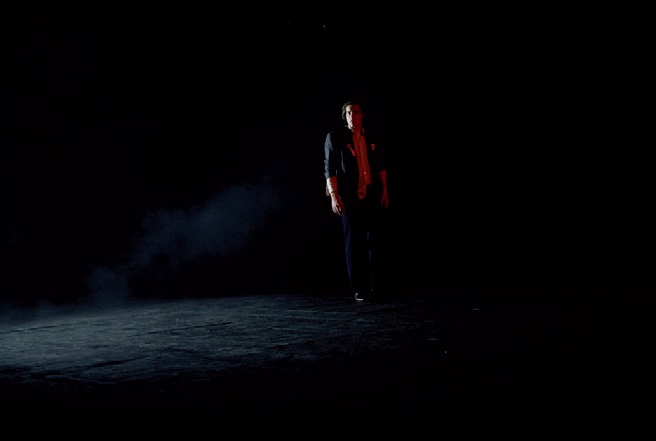
The performance Kazimír a Karolina, one of night scenes taking place in a parking lot; two sources cast the light onto the scene – cold light from the left side simulating front car headlights and red light from right simulating rear car lights, the rear section of the stage is cast with additional light for the reason of subsequent arrival of other actors. (photo: Klára Klepáčková)
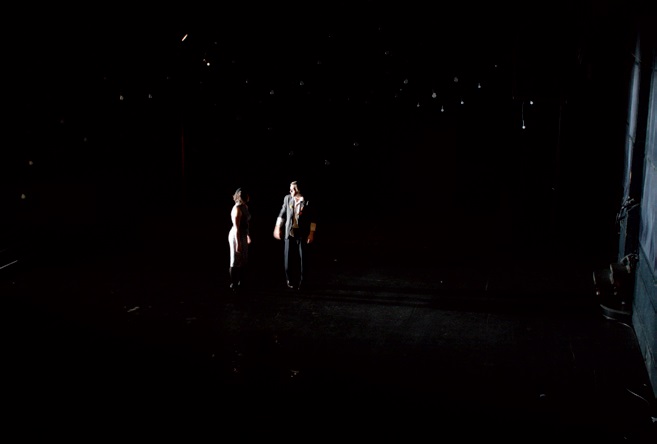
3. Swimming pool
Another case of change of “weather”, respectively of a plot that develops during a passing day, was the a juggling performance Plovárna (Prague, Ponec, 2014).The performance was inspired by the novel Capricious Summer by Vladislav Vančura and takes place in a simple scene of a swimming pool during a single day.
Since the beginning of the preparation of the staging, there was a clear assignment – the performance would be touring, i.e. it is necessary that it can be realized in different spaces and with different technical backgrounds. In addition to a passing day, another requirement was expressed: roughly in the middle of the performance, something like a dream has to take place in the scene (an afternoon siesta). It was thus necessary to distinguish the real world from this dream. A dream can be easily prepared with any other light, which doesn’t appear during the performance until then and even after. With a help of headlamps with cold and blue filters, this task can be accomplished without difficulty. And a passing day? The start of the performance begins with lights shining from the front and mostly from the right side. One proceeds across various bowling or acrobatic pieces, to the middle up to the end, where the left side produces more light. In such a way, it seems as if the sun passes over the heads of spectators and the whole day passes within one hour. The performance is full of other effects as well, but this main line can be implemented almost anywhere with a minimal number of instruments.
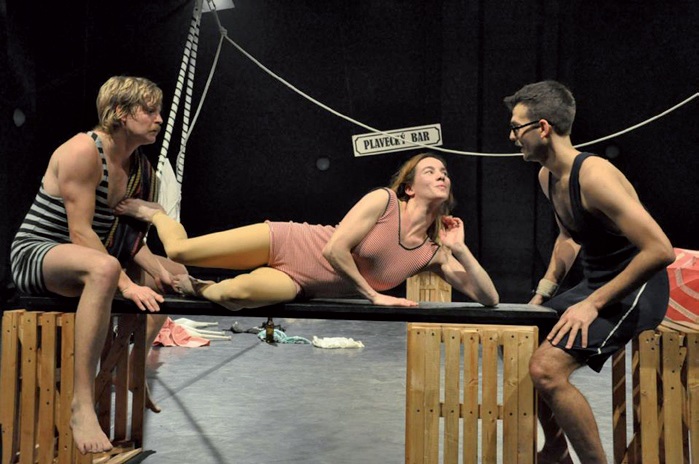
Performance The Swimming Pool, where an entire day goes by during an hour. A rear contra light can be noticed that shines for purpose of the realization of a lighting joke; the photo precedes the situation of the sun being covered by a cloud that is turning out the appropriate front light. (photo by Marianna Stránská
It is obvious that for creation of a stage lighting design is not mere mastering of lighting techniques without seeing a larger picture, finding ideas and a kind of wit. The impact lies in simplicity and too complicated and difficult creation of effects is actually impossible, despite all efforts to approach the real world in the theater. Theater should primarily entertain and any successful and spectacular spectacle enhances the impression greatly. Often at the cost of a simple, admitted trick.