Case studies
Case studies
1. The Miracles of Mary
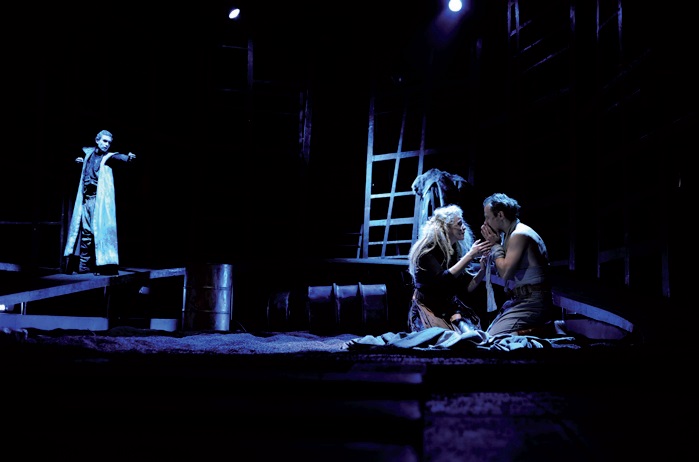
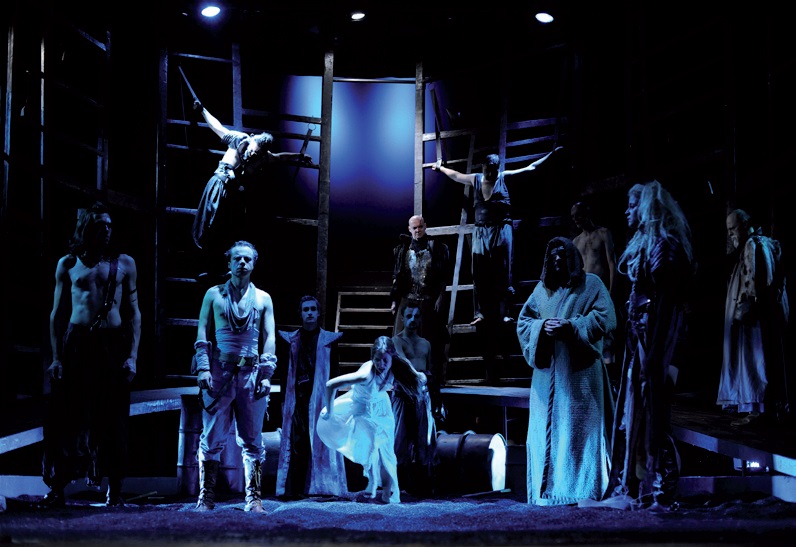
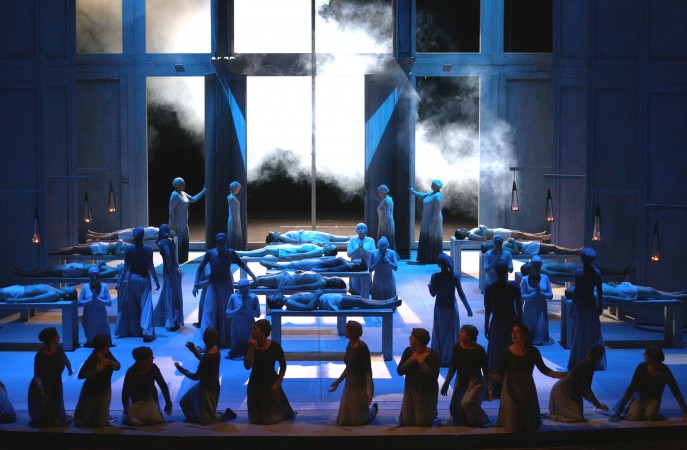
A scene from The Miracles of Mary (National Theatre in Prague, 2010), there are approximately 40 actors on the stage and several layers of the lighting design to the depth. They can be simply described as the three key elements of lighting layout: first warm “white” plan of kneeling women in a highlighted field in contrast to the central rear plan in light blue wash, which is accentuated by back light through the scenery. Compare it with the light plot – this blue is made of PARs with filters L200 and frost R119 (frost – a diffusion filter, causing compact, homogeneous surfaces) from three battens each with ten PARs, plus PC lanterns from FOH position), the white back light is probably the HMI 2.5 kW – this type of a source has specific color temperature that is close to daylight (about 5600 K) and distinct intensity. If the fact is taken into account that there had to be about 60 lights in this single scene, on can easily calculate that with an average number of 150 cues for a performance, the task of a lighting designer is to think within the logic of groups of lights and their combinations, of colors and their combinations, positions of angles of lights etc. Thus no romantic fine art, no experimentation – pure mathematics and physics with the necessary dose of real imagination and experience.

This is an international comprehensive plan of lights – the types, number, positions, colors. This one does not contain particularly the numbers of the circuits and their focus, because it would be too graphically chaotic. It is the task of the head of lighting team to arrange an accurate patch and focusing of lights so that the design would work according to the intent of the author and “handle” correctly the programmed cues. If the patch and focus have been done differently, this setup would create totally different visual content on the stage. By the way – quality of technicians can be recognized among other on the basis of whether they are able to read a light plot, respectively, whether they can create it themselves. For touring performances, it is standard that the original light plot is adapted into a given area by the head of lights so that the resulting appearance is closest to home as much as possible.
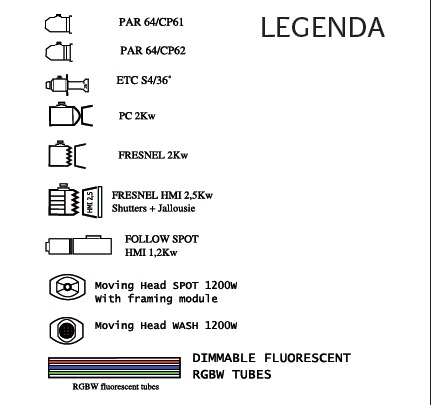
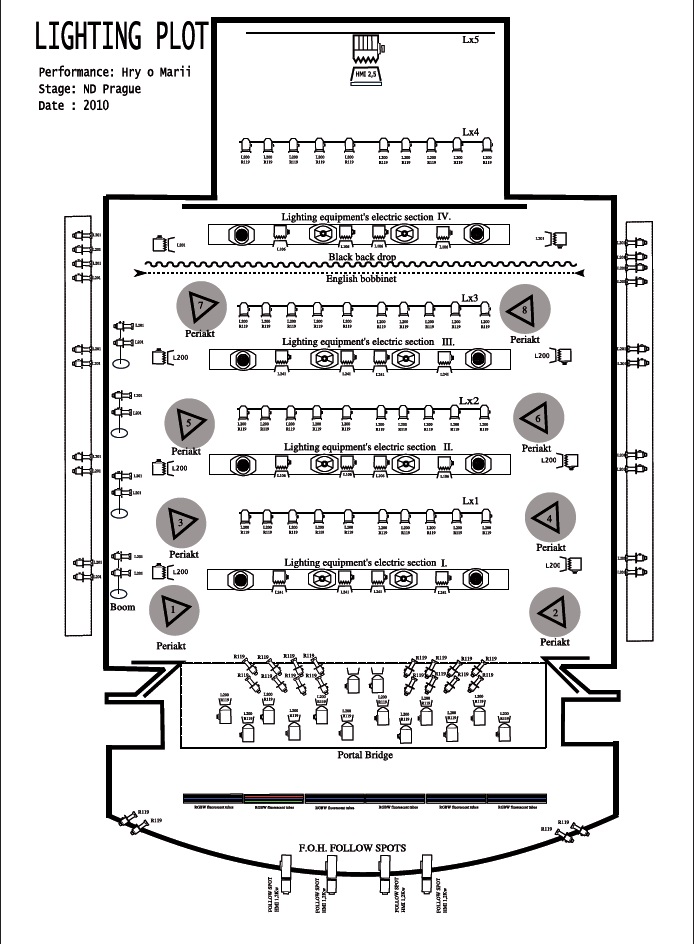
Miracles of Mary, light plot by Daniel Tesař.





2. Rusalka
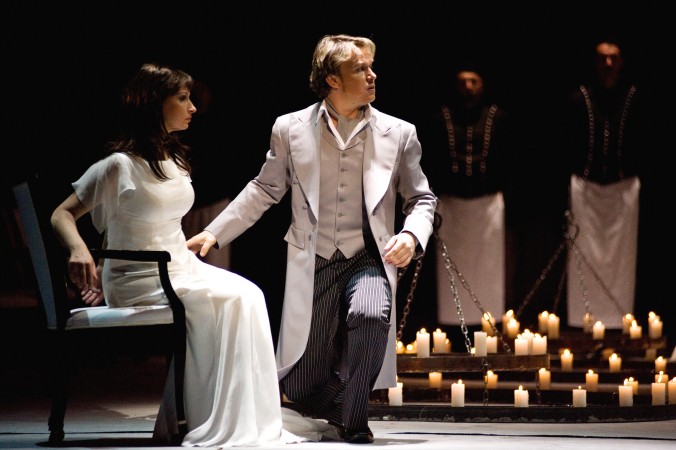
A scene from the opera Rusalka (National Theatre in Prague, 2009) – unlike the present day expressional dance, the opera is epic, “big” production. It’s a challenge for a lighting designer to technically deal with the facilities of the background of a theater – use of fly bars for set design, problematic angles between individual layers, etc. Note four layers of the plan – (fore) stage, first proscenium arch, second oblique proscenium arch, backdrop. Although the space for positions of lights decreases with the depth of the stage because of the set design, the light in the rear plan is homogeneous, doesn’t create distracting shadows (sidelights were used) and furthermore highlights the scenery translucently from the rear, which compose the contrast component of the scene. The blue-themed (fore-) stage harmonizes with the rear plan in the “white” (i.e. light without filters of about 3500 K) thanks to its sensible work of the set design – white dance floors, white walls of the proscenium arch, white backdrop, white costumes.

Rusalka by Antonín Dvořák, National Theatre in Prague, design by Daniel Tesař. Source: http://www.narodni-divadlo.cz/cs/predstaveni/5318




Similarly as there are some specifics in the preparation of a theater performance with respect to the genre or type of theatrical space, the process of the emergence of a performance is different in relation to the type of production, i.e. the production / operational system, in which (not only) a lighting designer and technicians work.
3. Flashed By
Dance performance Flashed By (Nanohach)
Assignment and inspiration
At the beginning of the production, there was a poll that was passed around by the choreographer and author of the project, Lenka Flory. The question was: What kind of a woman is inscribed in your memory as a woman whom you admire and identify with? The resulting figures should have served to create associations connected with them and then they would have been used for fabrication of a story, which should have been manipulated into two different interpretations. The whole concept of creating reminds of a particular social game with complex rules, through which a one hour dance solo narrates about female heroines and their ideals. Means of expression used in the performance should have been minimalistic, both in lights, sound and costume as well as in video projection and should have brought several distinct motifs that might have carried significance in themselves or they could have been combined. And right the use of combinations changes their original appearance and creates different meaning each time to the viewer.
Preparation of a lighting design
During initial considerations about the visual side of lighting, these basic elements were found:
- Strong, sharply focused sidelights in two color shades (without a filter with a slight correction Lee 202 – ¼ CT Blue) spatially delineating the body of a dancer, sidelights by the floor also eliminate the white floor and rear projection screen as well so that they can be used simultaneously with projection and so it would not overlap / erasing it.
- Side lights of greenish color (Lee 242 – 4300 fluorescent K) illuminate only the white floor from a low angle, in such a way that it don’t shine onto the projection screen and the dancer can be only sensed in a reflection – thus the figure “disappears” in grayish dusk of reflected light.
- The light placed onto a moving cart that throws light at the dancer from the gradually changing angle while her long shadow shifts slowly.
- The light reflected from the cylinder of mirror foil, placed on a slowly rotating phonograph – a sort of a ” lighthouse”, light in the distance.
- PAR64 CP61 hung above the center of the stage on a movable arm allowing either direct lighting of a dancer with a direct beam of light anywhere on the stage, or lighting with the help of reflection from the distorted mirror foil that hangs over the back of the stage, caused by wide contra light – it evokes an image of slowly moving clouds on the white floor.
- Reflection from a similar foil placed behind the cyclorama, however, with the multiplied number of PARs, connected separately – an effect of variable fire on the cyclorama highlights the silhouette of the dancer standing in front of it.
- A strobe light placed behind the cyclorama allows to highlight selected moments of the performance and to blind audience for a moment and to transfer their attention elsewhere, to disrupt their concentration.
- White rectangle of light from the projector, available to be used as a contrast to the warm up to orange light from the PARs.
- Strong front light from a group of PARs (CP62) focused on the white surface of baletizol and projection screen, primarily used for lighting of the hall with the help of a reflection from white areas, but also during the performance as FOH.

Performance Flashed By; strong, sharply focused sidelights of profiles delineate in space the body of a dancer (Photo: V. Brtnický)

Performance Flashed By; back lighting by reflection from the deformed sheet foil hanging over the back of the stage evokes an image of clouds on a white floor; due to the location of the source of light on a movable DMX arm, this effect gradually transforms itself (photo: V. Brtnický)

Performance Flashed By; reflection from a similar foil that was used for back lighting, this time located behind the cyclorama, causes an effect that is reminiscent of an image of flames on the cyclorama and highlights the silhouette of the dancer standing in front of it (photo: V. Brtnický)
Technical production
Already at the first implementation meeting, it became clear that technical-productive part of the project would be more complicated than the production and choreographer had expected. It became obvious that three data projectors would be needed: one positioned above the auditorium for front projection onto the rear projection screen, the second over the center of the stage for projection onto the floor and the third, placed on a movable arm for projection of details at various, precisely defined locations at the stage (e.g. the projection of flame onto the dress of the dancer). Other specifications were even more adamant. Projectors for front and top projection should have been as similar as possible, if not identical, so the images could have been arranged together well, but for the upper projection, it was necessary to use a projector with a very wide lens to achieve maximum of an image from a standard height of 6 m. The third, mobile projector should have been as light as possible because of the capacity of motorized arms, but with the greatest luminosity available, so that the image assert itself in competition with other projections and lights. As the estimated number of the video sequences approached twenty (eventually it crossed it) and some videos should have appeared from different projectors, it was obvious that the overall handling of projections would be necessary to be managed synchronically from the lighting control board with the help of a media server.
Using projection in this range also determined the size of the stage. The maximum size of the upper projection with the use the widest available optics from the distance of 6 m in 4: 3 format (a video format closest to the square) would be 6 × 4,5 m, and therefore the dimension of the floor should have been of such size. Fortunately, it was a solo dance and thus the surface was sufficient. The dimensions of a screen should have been also corresponding to the dimension of the floor, but after the first rehearsal unveiled that the optical effect was unsatisfactory and so video format 16: 9 was used for this front projection and it reached 6 m in width and nearly 3.4 meters in height in actual implementation. A screen of such dimensions had to be acquired by the company from the budget for staging. Other technical equipment had to be borrowed or hired, including console board and the USB / / DMX, barndoors for fading projections, controlled by DMX protocol and projectors. There is probably no need to explain to anyone that regular commercial rental rates of all necessary equipment are not within financial limits of any independent dance group living from the grant system. (purchase cost of wide lens for the top projector would swallow the entire budget of the performance.) It is often an unsolvable situation – if the owner of the technology receives a commercial contract in the date of the performance, it is not possible to rely on discounted (or free) loan and the performance can be canceled.
Rehearsal and preparation
Production of the Flashed By was taking place with interruptions for four months in three main rounds. After preparing the choreography and video material during three weeks, followed by the first technical “try out” in a theater space – work on lighting design, music, viewing of video footage for the first time live, and their mutual interconnection with dancing. During this week, a detailed script of the performance came into existence and also specific requirements for technology came out of it. For example, it turned out that controlling the projection from the lighting console is absolutely indispensable. A following three-week break was dedicated to getting needed parts of technology. The technology had to be at the lowest possible price, while functional, reliable, compatible and most importantly available for all rehearsals and scheduled performances: the technology was collected out of seven places in the city. The last round of rehearsals took place for a weeklong period of time.
Here, after two days of interconnecting, programming began and the major part of the performance was settled into a more or less satisfactory form. But throughout the whole time, new and new videos were being shot and processed, which replaced the old versions and then were inserted into somewhere else. Work with video projection and especially its processing, rendering is very time consuming and the entire team has to have tremendous patience. There is always waiting for something and the work progresses forward only very slowly. The last phase of creation actually proceeded after forced month long intermission during the three days before the premiere at the Ponec theater. ( All the different places with different spatial or technical layout complicate the job considerably, however, these experiences are beneficial for the future life of a hosting performance)
Working with the media server
Production of Nanohach worked with three data projectors and about thirty video sequences. Such an amount of projections and options cannot be handled from an ordinary player, a special computer for work with video is needed – the media server. How it works and how it is connected? There are several programs for media servers. In the case of the Flashed By, there was the program Arkaos V-Jay available, which is more user friendly software version of this brand. It is not so much difficult to install, but cannot do so much as the “large” Arkaos. But it was sufficient for production of the Flashed By. The Arkaos V-Jay has three control options: either to connect it via MIDI output with a MIDI controller, or the videos can be simply mapped on a computer keyboard – then they are launched by pressing the appropriate button, or the media server is connected via USB / DMX with the lighting console. The “magic” converter is an electronic box, into which a USB cable from a computer is connected and on the other side, a cable with DMX connector into the light console is fixed. The required video sequences are assigned with a number of the DMX circuit (patch) in the computer and it is controlled from the lighting console in the same way as the lights are turned on.
The advantage of this system in comparison with the previous technologies of control is the possibility of smooth blending of video sequences instead of jump shift and setting its intensity similarly as it is possible with conventional instuments. Attributes (properties) of the video, including the assignment to the correct projector, are set for each patch separately in the media server.
Conclusion
The performance Flashed By of the Nanohach group faced big problems throughout all the time of creation, caused by lack of financial support for their project. In contrast, the team succeeded in linking the basic stage elements of the performance and it’s apparent from the results of the work that the choreography, set design, sound, costumes, lights and video projections were created together and influenced each other from the very beginning of the creative process.
4. Markéta Lazarová
Markéta Lazarová in the ABC Theatre
Though it is an available option for directors to select a lighting designer, it doesn’t necessarily happen so often as it is very common that a lighting designer is perceived as a redundant expense in an overburdened budget and its role can be assigned to a local lighting technician. Furthermore, the person responsible for the visual aspect of a performance is the set designer. As the functional relations in a theater vary according to many factors as the size, financial mean available etc., also the role of a lighting designer may be more or less significant or necessary in the given performance. Here, the role was a role of a technician and operator of a lighting console who follows the demands and request of the director, program the lighting console and is responsible for flawless course of rehearsals, dress rehearsal, premier and subsequent reruns. At the initial meeting, the main issue was the stage and costumes. Possibilities and requirement of lighting were considered separately at a meeting with the director, where he was given information about technical equipment of the theatre as well. This was according to a well-established model with an exception of one small, but essential detail: the director requested several headlamps for rehearsals, which was a good sign.
The organization of rehearsal
A new staging is rehearsed about twelve weeks from the first reading rehearsal to the premiere according to the custom. First, in a rehearsal room, then even in a sort of a stage and about four weeks before the premiere, there comes the so called technical rehearsal when the entire scene is built up for the first time and lighting comes into play. The entire lighting is created during one day (!) and all light changes as well in the ideal case. A dress rehearsal is usually the day after the technical rehearsal. The last three weeks before the premiere are always the most demanding for the entire technical staff of a theater. At night and early in the morning, everything is being prepared for rehearsal, during which light and sound changes are mixed with action at the stage, and after the rehearsals, the scenes are being immediately dismounted and new scenery is built for the evening.
Lighting Design
For lighting of the stage, front lights were used to divide the varied scene into two sections, although lighting from the sides was predominant in the production. Significant, mostly cool hues of LED wash was interconnected with a special combination of bright greenish filter of an ancient date of fabrication (a foil of the celluloid treasure was discovered in a storage of discarded lighting equipment) and a soft cold correction Lee 202 – ¼ CT Blue. A wooden structure surrounding the stage was being penetrated by the light from unfiltered PC 500 W, located 2 m above the ground. Furthermore, low lighting was used from three open traps that were partially covered with wooden bars and then strong floods of three rows of PARs (CP61) covering the entire stage, and projection foils were used for brightening as they were located behind the scene in order to reveal two rear designs of the performance – images of death and monastery. However, primarily, the intelligent lights was the keystone of the work that carried most of the work during the performance for the entire duration of the performance. In total, all the possible lights that are available in the theater were used for lighting – 200 conventional lights, sixteen LED washes, seven intelligent lights (four spots lights, three wash lights).
Programming
The work with intelligent lights, on which the lighting design of Markéta Lazarová was based, required very good organization and preparation of moving heads before the start of programming. It means careful preparation of a variety of positions, colors and quality of the light beam (focus, color, beam). The time, invested in these preparations, pays off later, because a complicated search for already used attributes of setting of the moving heads is avoided. Light changes are programmed during technical rehearsal usually without actors. Extras are used from present technicians. For proper setting of intensity and selection of the colors of light, it is very important to have at least a part of costumes. When creating actual lighting cues, the director and his artist progressed in a very precise manner (an average of five to eight changes on one page of the text), so technicians were changing the design of the production constantly up to the preview.
Although these two performances were coming into existence under different conditions, the authors weren’t discouraged by large technical demands of their vision. They took the lighting design as an equal partner of the set design and stage action, which paid off to them well. Both the approaches had their cons. In the case of artistic production in terms of an independent theater, it is mainly the lack of financial support for their work, in the case of creating within a stable institution of a permanent venue, it is inflexibility and ” petrifaction ” of rules as arising from the complexity of the smooth running of a large theater house. There is no perfect condition available and it can be only approached when artists and production come out to meet and find a joint functional compromise.