
Case studies
Case studies
1. Found & Lost
A little bit about the colors: Cold is warm.
Ponec Theater, Prague. 2014
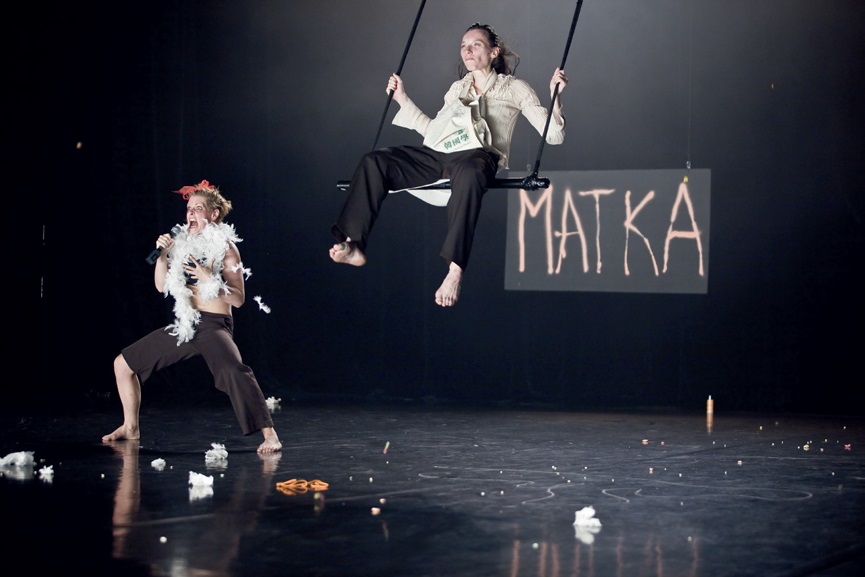
This very sober set design is completed with light that delineates the dimensions of the scene: backlight PAR fixtures from left open the depth of space and also its verticality thanks to a cloud of mist; dancers are also lit from front ground ramps MR16, they don’t cast shadows on the floor or on the backdrop; the angle from the ground position also causes monstrous appearance.
In his work, P. Kotlík often rhythmize and determine the dramaturgical line of the choreography by application of a color scheme. He takes the surface as a base – he covers the theater space in such a way that it would work as a whole. He combines various positions and angles (electric pipes, side towers and ground lights). To cover the entire area, he uses side lights in the level of a figure – side lighting- from both the sides, which models the figures of dancers in a plastic, real, faithful manner. It’s a classic procedure of ballet and dance lighting. The unifying principle of his approach is generally the contrast between “warm” and “cold” areas, but that doesn’t necessarily mean to use warm and cold colors (blue in the base and orange in contrast), but rather a contrast of two shades of color, when one induces a warmer and the second colder impact.
The human eye is an easily deceived organ that is able, first, to adapt to very different lighting conditions (e.g. strong light versus twilight), and secondly to perceive contrast indistinctive at first glance (two shades of the same color).
Therefore P. Kotlík speaks of “zero” (which is a kind of niveau which defines white), the natural color environment to which a person is able to relate the perception of colors and dimensions: the viewer determines the color from the zero, or rather the atmosphere, because he lets himself a priori be carried away by the feeling not the racio during a performance.
If there is such a basis (though it doesn’t have to be shown on stage!) and the eye is given time to adjust, it is possible to create contrasts, even with the cold colors in two different shades, when one automatically produces a warm and the other cold impact. It’s based on a simple principle – similarly as is perceived the contrast between traditional tungsten bulbs and (cold) fluorescent tubes. During the performance Lost and Found, there were used side lights in ballet towers in two levels – at an angle of about 90 ° (body height) and 135 ° (bottom position, at knee level) when the top is warmer shade of color (L245 – Half plus green) and lower lights in the colder shade (L241 – Lee fluorescent 5,700 K).
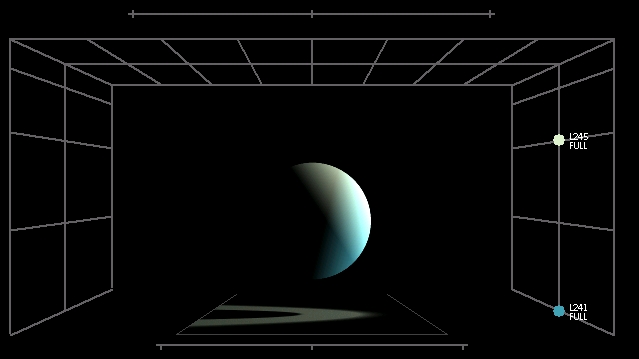

Paradoxically, both are rather cold in the color spectrum, despite that their combination has a contrast impact. It is, however, essential that both colors are placed in the same type of fixture (PC 1 kW). Usage of the same color (L241) in the upper PAR lights (P64 1 kW CP624), however, may work differently, especially with the regard to intensity: PAR doesn’t have even distribution of light across the entire surface of the light beam, and so it is more intense in the middle of the beam than a PC of the same input. If one needs to reach approximately uniform, compact lighting with combination of PC and PAR sources, it is necessary to reduce the intensity of PAR lights, which results in (another specific feature of a PAR) warming of a light beam (visibly lower color temperature). A PAR at lower intensity with a cold color filter emits much warmer color than the PC with the same color.
Thus in the performance Lost and Found, the upper PAR fixtures are used in such a way – they correspond to the PC with L245 at lower intensity (causing warm impact) and are as cold as PC with L241 at higher intensity (but providing stronger light).
For the purpose of the performance (and Kotlík’s concept where warm evokes cheerful and the cold sad atmosphere), cold shades (L241) are used in the scene with a dying mother – backlight PARs cast light at high intensity and lights from ground ramps MR16 as a additional source casting light from the front.
Let’s here briefly mention the fixture MR165 – small halogen sources that are located in the luminaire, placed side by side, provide the effect of multiple sources, so the lit figure or object does not cast a shadow. In the performance Found and Lost, the ramps are placed frontally on the floor (ground position) and replace the direction of the front light almost absolutely. Despite the fact that they are not colored, it is possible to combine them effortlessly into any color atmosphere, because it is not necessary to use high intensity – their role is to provide additional light to essential scenes with the front lights so that the key atmosphere would prevail. It remains to add that the red area can function as a “niveau”. It is possible in the context of the cold colors L241 and L245, which are prevalent in the whole performance and determine its “zero”.
One time lit area in the red color (L182 in the type of source AHR) then contrasts with the cold shade so that the adapted eye perceives it as extremely warm, open color revealing more space – hence the comparison to a niveau. Although eye senses that it is really red, it determines it as the neutral white in the sense of affective perception.
Finally, let’s mention the profiles with Gobos, which leave a “non-white” impact, although not being equipped with any filter. A Gobo pattern, projected onto the surface of a certain color, is in context with it and in relation to the intensity and “colorlessness”, the eye decodes it as a supplement, a detail of the key color of the atmosphere, therefore it moves the temperature of the color closer to the predominant color.
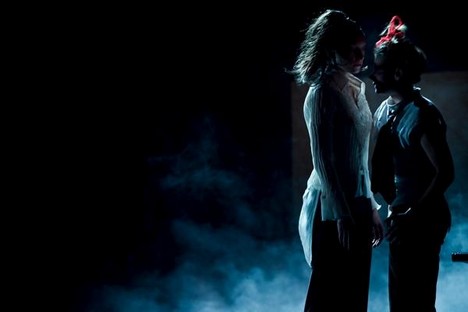
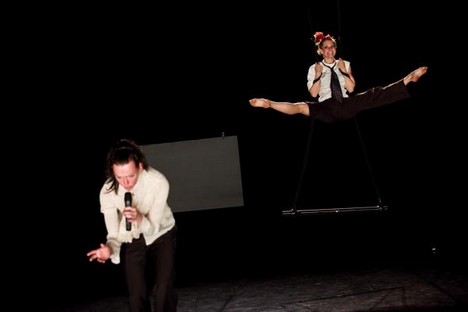

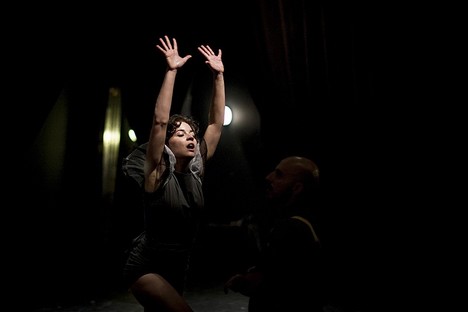
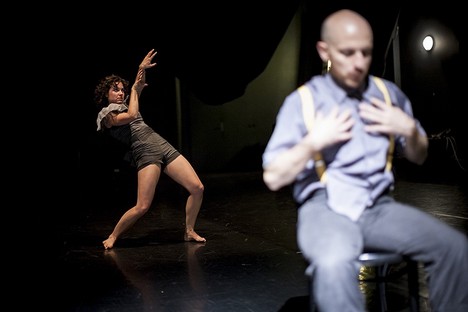
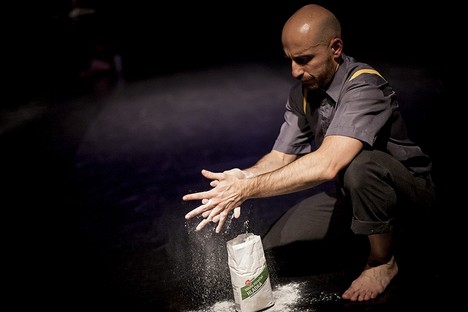
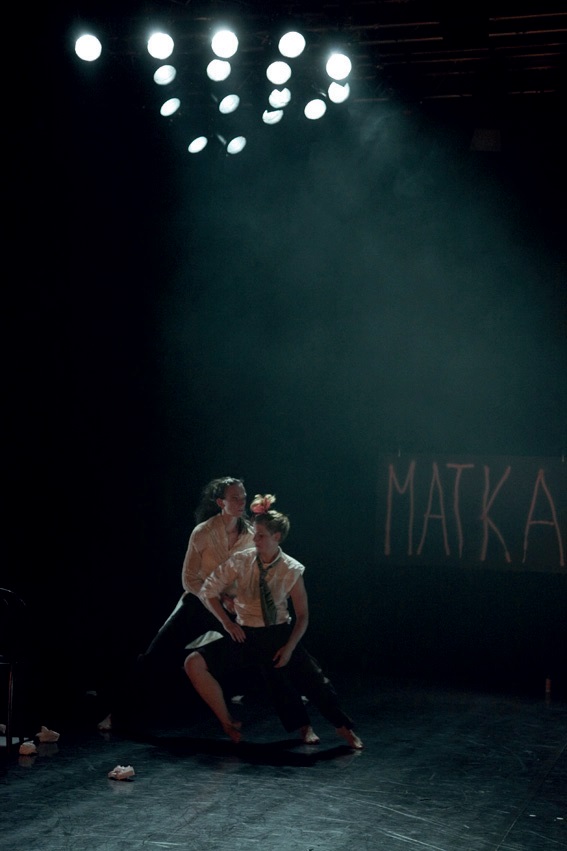
A bunch of cold PAR instruments used for backlighting determines the key coloring of the scene, dancers are lit by additional back light from the front by ground ramps MR16 at low intensity, so they have warmer impact, enhanced by white color of the costume.
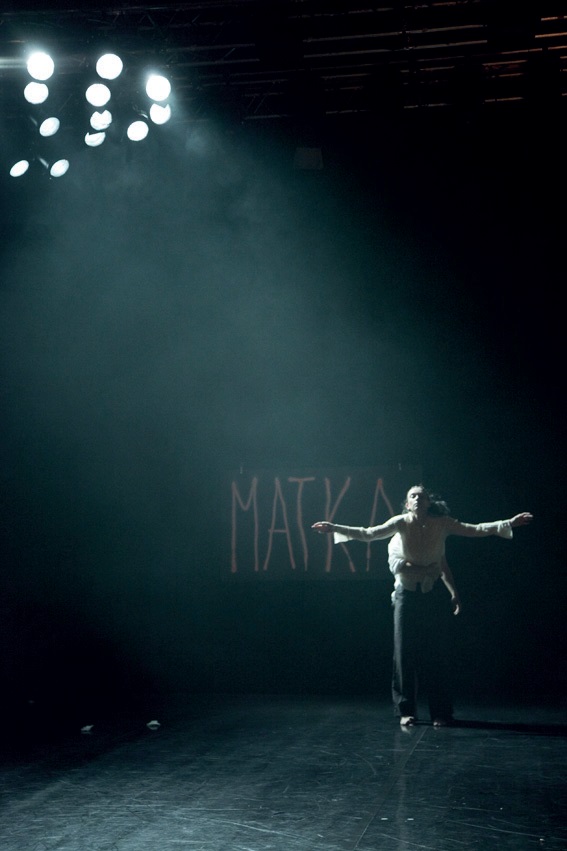
PAR instruments used for backlighting with cold light, this time without any additional light; using light from only one side bestows a dramatic effect to the situation and tension, a part of the dancers’ body is in shadow; a cloud of mist highlights the focus of the situation.
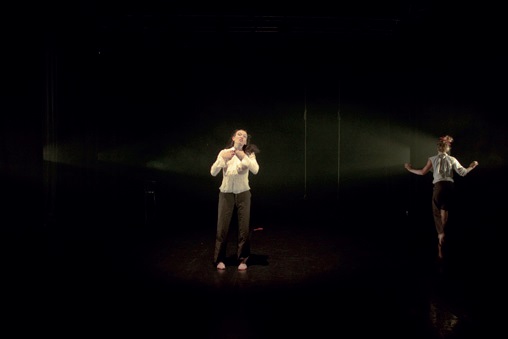
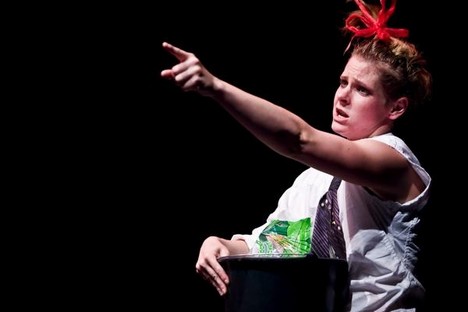
PCs used as side lighting with warmer L245 correspond to white (colorless) spot light from above; use of side lighting changes the dimensions of space, which fades away in the rear, with vanishing vertical dimension; the dancer on the right is lit only from the side, despite of that the figure has vivid impact and is lit well enough.
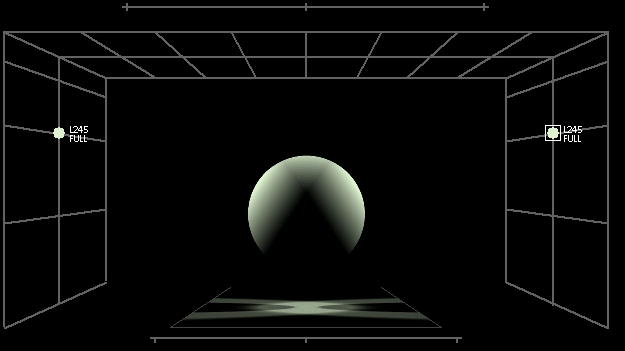
L245
2. Inteview: Pavel Kotlík
Do you have your own style, your language that you use and repeat? You are very often associated with intense color lighting.
I like very much to use fields and an evenly illuminated whole on the stage. The most distinctively floor, front, back, side. This is a basis for me; I believe that dancers are best seen in the direction of the side lighting from a tripod or towers, usually at the level of the head. Furthermore, the side lighting models bodies well.
The direction and angle of light is just one thing, but the coloring will help to produce more. I am very often too descriptive, which means that I am trying to add a color to the given situation as I perceive it. The key to all this is actually simple: I choose dark colors for a sad atmosphere and happy colors for a cheerful one. One old lighting electrician’s advice is that when a water goblin creeps out, use the green color, when the devil then red. (laughs) It works just in the same way, only I just created my own law. There’s a zero, showing the sort of “a normal situation”. This zero doesn´t need be actually used in the show at all costs. It serves as a sort of a springboard, from which I determine to myself what’s warm and what’s cold. It doesn’t have to be always blue and orange, it may be completely different colors, but they should always stand in contrast.
This means that a spectator can perceive the pinkish white light to be white after an hour presentation… That is something I like.
So what is the “zero”, the center in the case of the Lost and Found show?
243 Lee Fluorescent 3600K from the company LEE filters, that is the zero, which is, however, not actually used there.
So you define the “zero” as a springboard – as the basis from which you seek for another color?
Exactly so, and I proceed further actually quite intuitively. In the case of the Found and Lost, the side lighting is created with PC 1Kw. There is 241 Lee Fluorescent in the lower lights and warm 245 Half Plus Green in the upper ones. There is no 243, even though it was my “zero” at the beginning. In these colors, there is dark green inserted into the PAR‘s. A PAR is stronger as you know in comparison with the PC, which means that the light gives warmer impression. The cold floor is used, for example, in the scene where the mother dies. This scene is so the coldest one, it’s such dying light.
In the case of the Lost and Found, I got a request from choreographer Charlotte Öfverholm for warm and cold colors, so I gave it to her. Only in shades of green. Red function there as “working light” and on the other hand, profiles with gobos provide non-white impression.
Many lighting designers talk about the stage as a canvas, on which they draw their images. Would you agree?
It is a playground where you can play. It is not a canvas, the lights itself don’t exist. You can dance alone, but that’s stupid, you can play the music to yourself and it’s pretty good, but to turn on the lights just for yourself, only few fools as us really do that. I disagree and do not think that theater is like a canvas. It can be a canvas within a story, but it does not work like that as such.
The remaining part of the interview is available here.
3. Last Minutes
The performance Last Minutes was an interesting task (Prague DISK, 2011/2012) where the director wanted to create the so called halo optical phenomenon in a scene, in which there would be an Antarctic research station and snowy garden in front of it (white ballet floor). Using fine steam is simply not possible in theatrical conditions. It was therefore necessary to think about how such a phenomenon would manifest itself in the indoor environment, when it is actually visible only in the sky. Obviously, it will be strange and unnatural light. In this way, the colors were used in such a way for changing the scene in color (cold, yellow and red hues) to the odd reflections from the white surface of the floor, with which strange light should be guaranteed. In one moment, when the halo was noticed by spectators, strong front lights were used that hadn’t been used until that time. In such a manner, the desired effect was simply achieved.
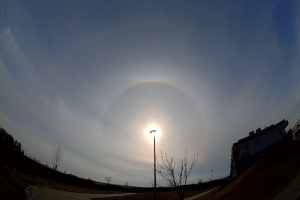
At the photos taken on 22. 2. 2014, more halos can be seen at once: 46° halo and 22° halo, Parry arc, light pillar. It is worth noting the areas of pale light of landscape despite the fact that the contrast of the image was adjusted (photo: Štěpánka Kosová, available at: http://show.astro.cz/upload/20140222StepankaKosova_Komplex2.jpg)
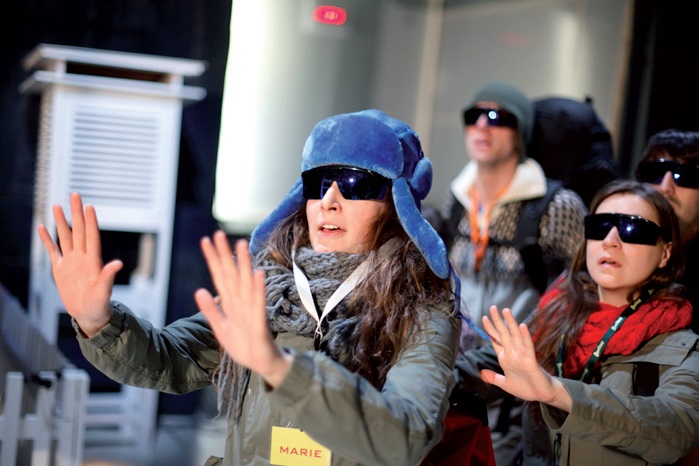
Performance Last Minutes, in which halo phenomena were simulated by stage lighting instruments; reflection of front fixtures on actors’ sunglasses should imitate the light of a hall phenomenon. (Photo: Jan Hromádka)